Read the passage given below and answer the following question.

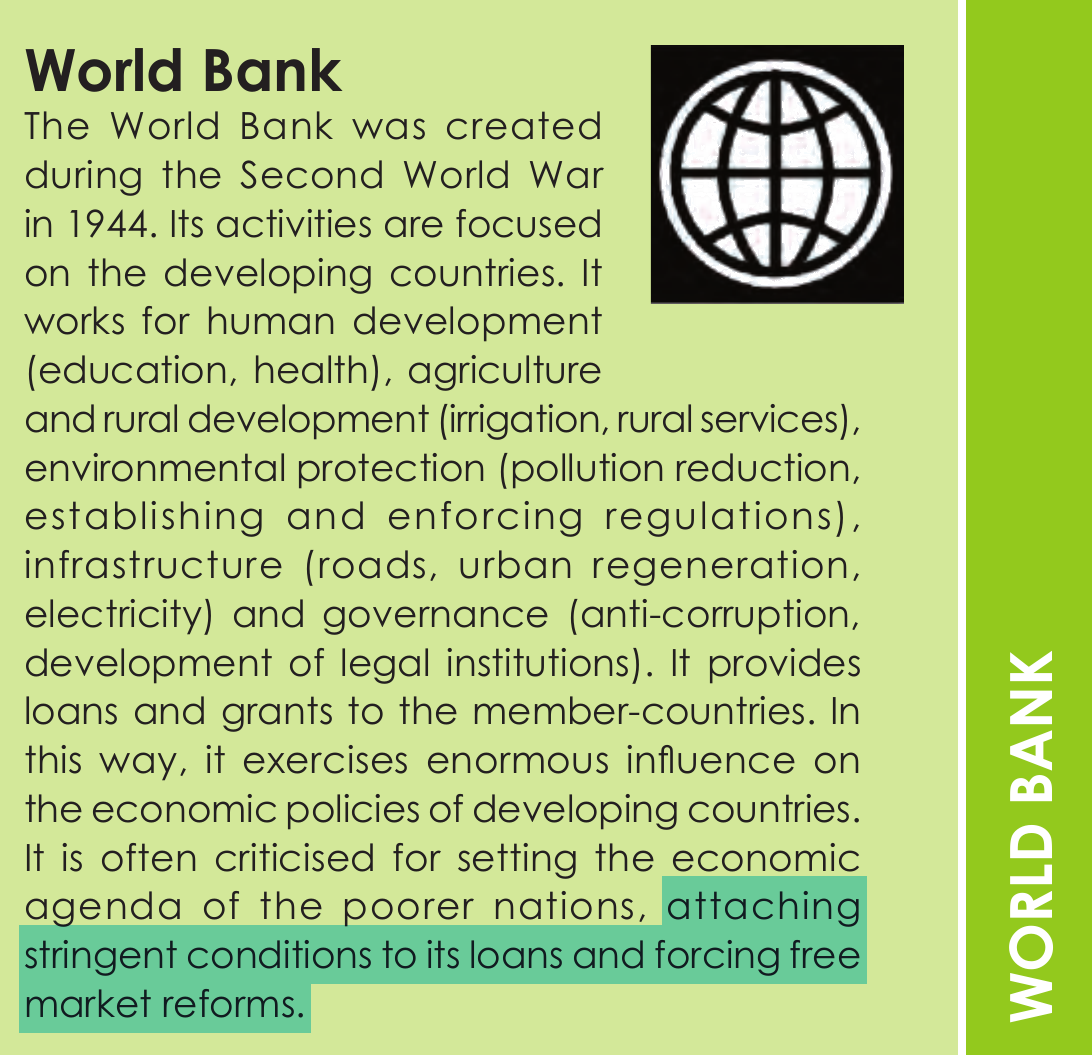
The World Bank was created during the Second World War in 1944. Its activities are focused on the developing countries. It works for human development (education, health), agriculture and rural development (irrigation, rural services), environment protection (pollution reduction, establishing and enforcing regulation), infrastructure (roads, urban regeneration, electricity) and governance (anti-corruption, development of legal institutions). It provides loans and grants to the member-countries. In this way, it exercises enormous influence on the economic policies of developing countries. It is often criticised for setting the economic agenda of the poorer nations, attaching stringent conditions to its loans and forcing free market reforms.
The stringent conditions attached to the loans given by world bank is called
Answer & explanation
Correct answer: option 3
The correct answer is Option (3) → Structural Adjustment Program
The stringent conditions that the World Bank attaches to its loans – free market reforms that the borrowing country has to carry out – are known as the Structural Adjustment Programme.
Note: None of the NCERT books – the pre-rationalised, 2023-24, 2025-26 or 2026-27 edition – uses the term ‘structural adjustment programme’ for the conditions attached to World Bank loans. The World Bank box speaks of ‘stringent conditions to its loans and forcing free market reforms’, and the chapter ‘Recent Developments in Indian Politics’ calls India’s new economic reforms of 1991 ‘the structural adjustment programme’ (both are shown in the extract).
NCERT (2026-27): Contemporary World Politics — Chapter 4: International Organisations
World Bank box (2026-27): attaching stringent conditions to its loans and forcing free market reforms NCERT (2026-27), chapter ‘Recent Developments in Indian Politics’: “Context of the 1990s … Third, the economic policy followed by the various governments took a radically different turn. This is known as the initiation of the structural adjustment programme or the new economic reforms. Started by Rajiv Gandhi, these changes first became very visible in 1991 and radically changed the direction that the Indian economy had pursued since Independence.…” |