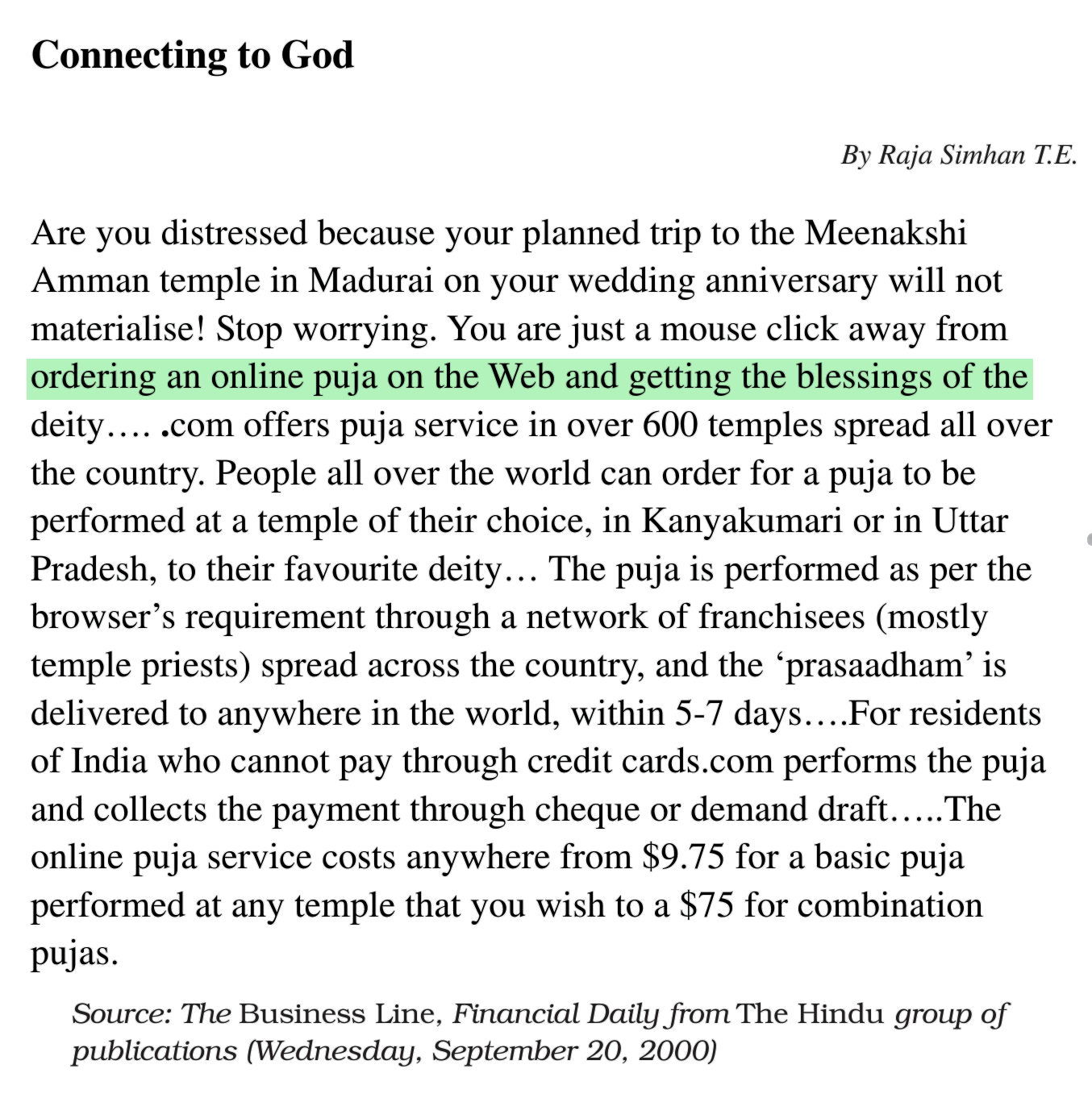
Online puja services can be understood as an example of :
(1) Modernisation
(2) Westernisation
(3) Secularisation
(4) Sanskritisation
Answer & explanation
Correct answer: option 1
The correct answer is Option (1) → Modernisation
Option (1) Modernisation — Correct. In its early sense, modernisation referred to improvement in technology and production processes. An online puja brings the internet, online payment and a delivery network into an old ritual: the devotee orders the puja on the web, priests perform it, and the prasad reaches him anywhere in the world. The ritual stays; the way of doing it is modern.
Option (2) Westernisation — Incorrect. M.N. Srinivas defines westernisation as “the changes brought about in Indian society and culture as a result of over 150 years of British rule”. Ordering a Hindu puja online is not the taking up of a western way of life or of British culture.
Option (3) Secularisation — Incorrect. In the modern west, secularisation has usually meant a process of decline in the influence of religion. Online puja shows the opposite: people still seek the blessings of the deity and only use a modern channel for it. The view that modern ways must lead to a decline in religion has not been entirely true in India.
Option (4) Sanskritisation — Incorrect. Sanskritisation is the process by which a ‘low’ caste or tribe takes over the customs, ritual and style of life of a high caste to raise its status. Online puja has nothing to do with one caste copying another.
Note 1: The box ‘Connecting to God’ on online puja services, in the section on secularisation of the chapter ‘Cultural Change’, was there in the pre-rationalised NCERT, the textbook of 2022. This box has been deleted from the NCERT book (2025-26), though the chapter and its section on modernisation and secularisation are still there.
Note 2: This is an application-based question. The box describes online puja services but does not name the concept they show; the answer comes from applying modernisation, in its early sense of improvement in technology, to the case: an old ritual done in a new, technological way.
NCERT (2025-26): “Modernisation and Secularisation … The term modernisation has a long history. From the 19th and more so the 20th century, the term began to be associated with positive and desirable values. People and societies wanted to be modern. In the early years, modernisation referred to improvement in technology and production processes. Increasingly, however, the term had a wider usage. It referred to the path of development that much of west Europe or North America has taken. And suggested that other societies both have to and ought to follow the same path of development.” “In the modern west, secularisation has usually meant a process of decline in the influence of religion. It has been an assumption of all theorists of modernisation that modern societies become increasingly secular. Indicators of secularisation have referred to levels of involvement with religious organisations, the social and material influence of religious organisations, and the degree to which people hold religious beliefs. Recent years have, however, seen an unprecedented growth of religious consciousness and conflict world over. However even in the past, a view that assumed that modern ways would necessarily lead to decline in religious ways has not been entirely true. You will recall how western and modern forms of communication, organisation and ideas led to the emergence of new kinds of religious reform organisations. Furthermore, a considerable part of ritual in India has direct reference to the pursuit of secular ends.”
Connecting to God (Pre-rationalised NCERT) |