The figure shows what happens in an economy when people suddenly become more thrifty and the mpc falls, with autonomous expenditure unchanged. The lines and points are marked 1 to 4.
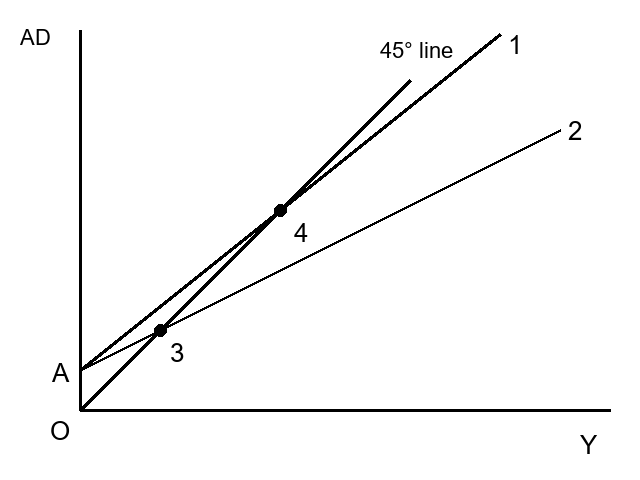
Which option identifies them correctly?
Answer & explanation
Correct answer: option 2
The correct answer is Option (2) → 1: AD line before the fall in mpc; 2: AD line after the fall in mpc; 3: new equilibrium; 4: old equilibrium
A fall in the MPC makes the AD line flatter: it swings down about the same intercept A. So the steeper line 1 is AD before, and the flatter line 2 is AD after.
The flatter line meets the 45° line at a lower output. So the lower point 3 is the new equilibrium, and the higher point 4 is the old one.
Option (1) 1: AD line after the fall in mpc; 2: AD line before the fall in mpc; 3: new equilibrium; 4: old equilibrium — Incorrect. The lines are the wrong way round; the line after the fall in MPC is the flatter one.
Option (2) 1: AD line before the fall in mpc; 2: AD line after the fall in mpc; 3: new equilibrium; 4: old equilibrium — Correct. Line 1 before, line 2 after; point 3 new, point 4 old.
Option (3) 1: AD line before the fall in mpc; 2: AD line after the fall in mpc; 3: old equilibrium; 4: new equilibrium — Incorrect. The points are the wrong way round; the new equilibrium is at the lower output.
Option (4) 1: AD line after the fall in mpc; 2: AD line before the fall in mpc; 3: old equilibrium; 4: new equilibrium — Incorrect. Both the lines and the points are the wrong way round.
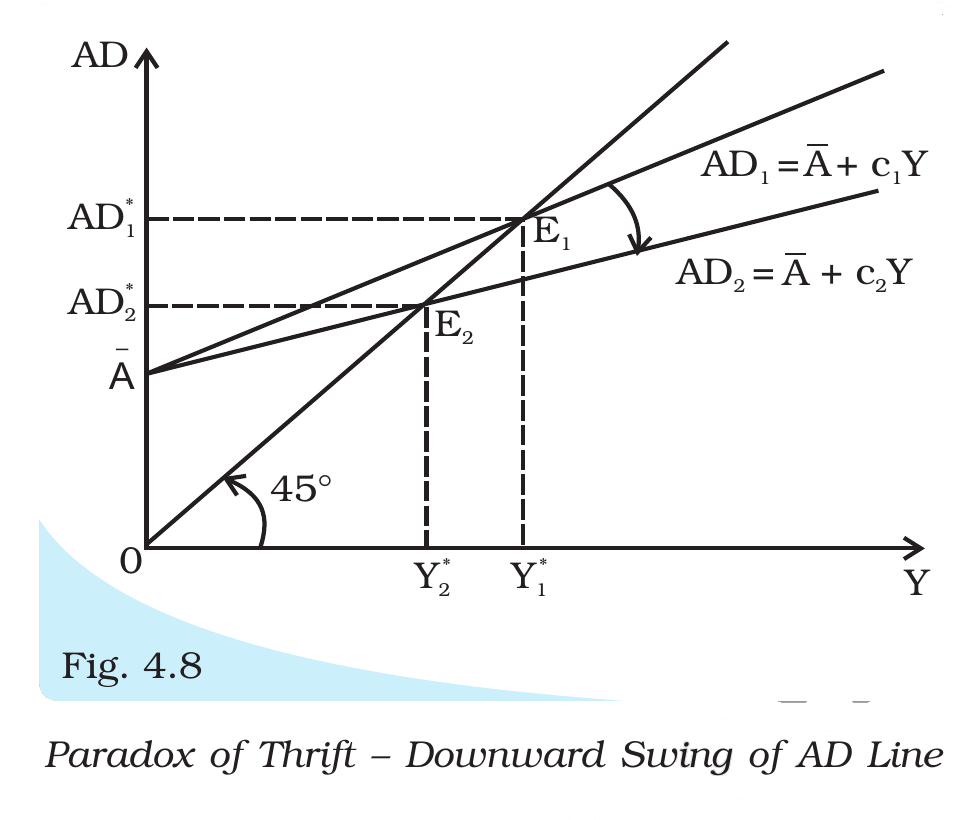
NCERT (2026-27): “Paradox of Thrift … When A changes the line shifts upwards or downwards in parallel. When c changes, however, the line swings up or down. An increase in mps, or a decline in mpc, reduces the slope of the AD line and it swings downwards. We depict the situation in Fig. 4.8.”
|