
In Sickle-cell anemia, the substitution of amino acid in the globin protein results due to the single base substitution at the sixth codon of the beta globin gene from:
Answer & explanation
Correct answer: option 4
The correct answer is Option (4) → GAG to GUG
Sickle-cell anaemia is an autosome-linked recessive disorder caused by a point mutation. One base change in codon number six of the beta globin gene changes the amino acid at that position from glutamic acid (Glu) to valine (Val). The changed haemoglobin turns the RBCs into sickle shapes when oxygen is low.
Option (4) GAG to GUG — Correct. A single A is replaced by U, so glutamic acid (GAG) becomes valine (GUG).
Note: A similar question was also asked in CUET (UG) 2025 on 22-05-2025 (Slot 2).
NCERT Extract:
Mendelian Disorders – “… Sickle-cell anaemia : This is an autosome linked recessive trait that can be transmitted from parents to the offspring when both the partners are carrier for the gene (or heterozygous). The disease is controlled by a single pair of allele, HbA and HbS. Out of the three possible genotypes only homozygous individuals for HbS (HbSHbS) show the diseased phenotype. Heterozygous (HbAHbS) individuals appear apparently unaffected but they are carrier of the disease as there is 50 per cent probability of transmission of the mutant gene to the progeny, thus exhibiting sickle-cell trait (Figure 4.15). The defect is caused by the substitution of Glutamic acid (Glu) by Valine (Val) at the sixth position of the beta globin chain of the haemoglobin molecule. The substitution of amino acid in the globin protein results due to the single base substitution at the sixth codon of the beta globin gene from GAG to GUG.”
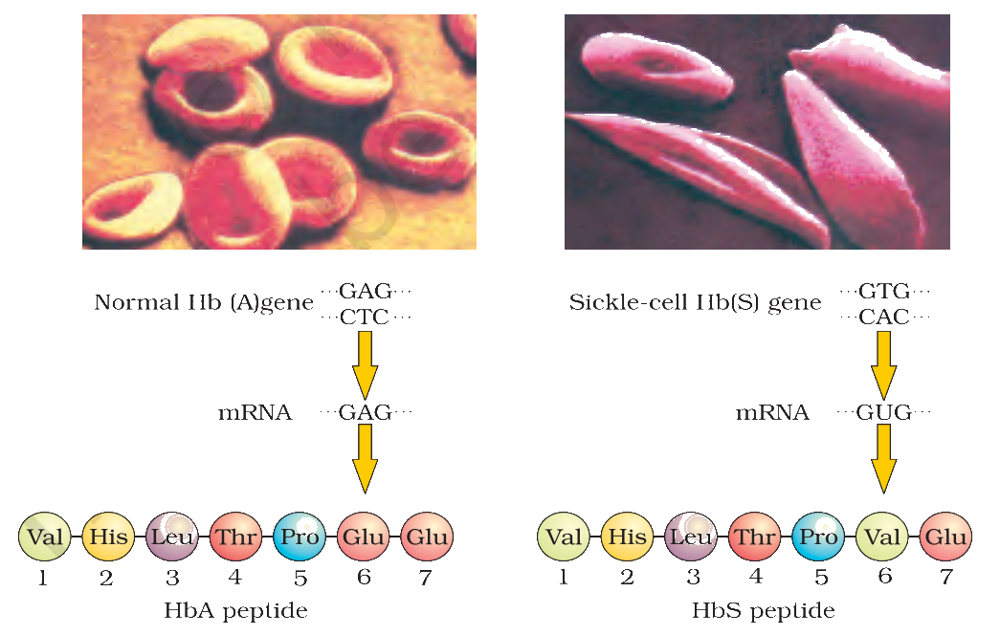
Figure 4.15 Micrograph of the red blood cells and the amino acid composition of the relevant portion of β-chain of haemoglobin: (a) From a normal individual; (b) From an individual with sickle-cell anaemia