Match List I with List II
| List I | List II |
(A) 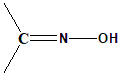 |
(I) Schiff's base |
(B) 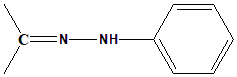 |
(II) Semicarbazone |
(C) 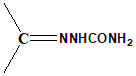 |
(III) Phenyl hydrazone |
(D) 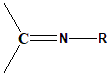 |
(IV) Oxime |
Choose the correct answer from the options given below:
Answer & explanation
Correct answer: option 2
The correct answer is Option (2) → A-IV, B-III, C-II, D-I
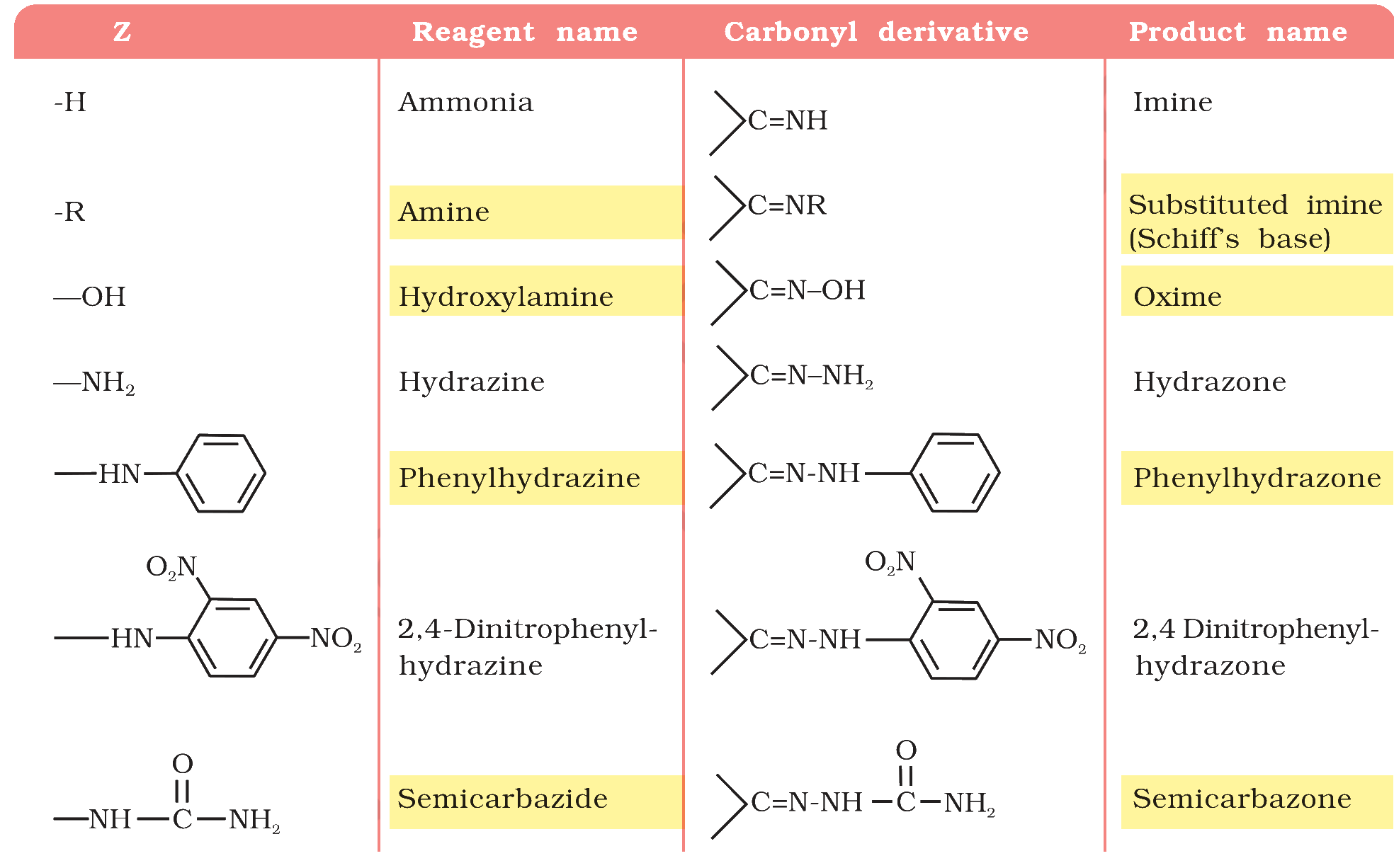
Ammonia derivatives H2N–Z add to the C=O group of aldehydes and ketones and then lose water, giving a C=N–Z compound (\( \ce{R2C} \) = the carbonyl compound) (acid catalysed addition–elimination). The product is named after the reagent:
\( \ce{R2C=O + H2N-Z -> R2C=N-Z + H2O} \)
(A) >C=N–OH — This matches (IV) Oxime. It is formed with hydroxylamine (Z = OH).
\( \ce{R2C=O + H2N-OH -> R2C=N-OH + H2O} \)
(B) >\( \ce{C=N-NH-C6H5} \) — This matches (III) Phenyl hydrazone. It is formed with phenylhydrazine (Z = \( \ce{NHC6H5} \)).
\( \ce{R2C=O + H2N-NHC6H5 -> R2C=N-NHC6H5 + H2O} \)
(C) >\( \ce{C=N-NHCONH2} \) — This matches (II) Semicarbazone. It is formed with semicarbazide, \( \ce{H2N-NHCONH2} \); only its free –\( \ce{NH2} \) attached to the other N reacts.
\( \ce{R2C=O + H2N-NHCONH2 -> R2C=N-NHCONH2 + H2O} \)
(D) >C=N–R — This matches (I) Schiff’s base. It is a substituted imine formed with a primary amine (Z = R).
\( \ce{R2C=O + H2N-R' -> R2C=N-R' + H2O} \)
Shortcut: A-IV and B-III appear in Options (2) and (3); C-II leaves only Option (2).
NCERT (2026-27 edition):
Addition of Ammonia and its Derivatives – …