CUETMOCK
  • Pricing
  • Mentors
Log inStart freeStart free mocks→

First test, then trust

Try a free CUET mock test.

Join 5,00,000+ students who rehearsed exam day on the exact NTA screen before sitting CUET. On the web and on Android.

Start free mocks →Get the Android app
CUETMOCK

India's #1 CUET Mock Test Platform. Original NCERT-based questions on the exact NTA exam screen — trusted by 5,00,000+ students since CUET 2022.

Get it onGoogle PlayScan to download the CUETMOCK app

Mock tests

  • CUET mock test series
  • Browse all papers
  • Commerce mocks
  • Humanities (Arts) mocks
  • Science mocks
  • Languages & GAT mocks
  • Free practice questions
  • Pricing

Resources

  • CUET exam guide
  • CUET syllabus
  • Universities accepting CUET
  • Expert blogs
  • News & notifications
  • Webinars & counselling
  • CUET score calculator
  • How we estimate your rank
  • FAQs

Company

  • About us
  • Our leadership & team
  • Our toppers
  • Mentors
  • For schools
  • Contact us
  • Terms
  • Privacy
  • Refund policy

Talk to us

+91 7696 6630 56info@cuetmock.comWhatsApp us

Our other platforms

  • JEE Mock — For IIT-JEE aspirants
  • NEET Mock — For NEET aspirants

Newsletter

Exam updates, study material and offers — no spam.

© 2026 NYC Ventures Pvt. Ltd.

701-702, Royal Business Park, Zirakpur, Punjab - 140603

  • Terms of use
  • Privacy policy
  • Refund policy
  • Contact us

iCUETMOCK is an independent preparation platform, not affiliated with the National Testing Agency (NTA). Always check exam details on the official NTA website.

  • Home
  • Mock tests
  • CUET guide
  • Pricing
  • Log in
Home/Practice questions/General Aptitude Test
General Aptitude TestVerbal ReasoningSyllogism

Read the given statements and conclusions carefully. Assuming that th…

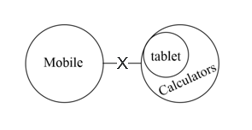
Read the given statements and conclusions carefully. Assuming that the information given in the statements is true, even if it appears to be at variance with commonly known facts, decide which of the given conclusions logically follow(s) from the statements.

Statements:

No mobile is a tablet

All tablet are Calculators

Conclusions:-      

I. No Calculators is a mobile

II. Some Calculators are mobiles

Answer & explanation+

Correct answer: option 4

Conclusion: either I or II follow

Advertisement

Practise more on Verbal Reasoning

Chapter-wise mocks on the real NTA exam screen, with solutions and your rank. Your first mocks are free.

Start free mocks →

Advertisement

Next questions

  1. In which among the following method sperm is directly injecting into ovum in assisted reproductive technology ?Biology · Reproductive Health
  2. Given AD=C+I+CY , change in autonomous consumption will lead to :(A) Change in equilibrium level of income(B) Change in aggregate demand(C)…Economics · Macro Economics: Determination of Income and Employment
  3. "Which of the following is correct about Savitri bai Phule ? 1. Savitri Bai Phule was the first headmistress of the country’s first school…Sociology · Indian Society: Continuity and Change
  4. Outsourcing of services like Deeksha’s teaching has intensified in recent times mainly because of which of the following?Economics · Indian Economic Development: Liberalisation, Privatisation and Globalisation - An Appraisal
  5. _____ is the term used to describe the level of stress that is good for a person and is one of the assets for achieving peak performance an…Psychology · Meeting Life Challenges
  6. Which letter will replace the question mark (?) in the following series? B, D, H, ?General Aptitude Test · General Ability
  7. Whose colossal statue has been found installed in a shrine at Mat near Mathura (Uttar Pradesh)?History · Ancient India: Kings, Farmers and Towns
  8. गद्यांश के अनुसार समाधि पर शपथ लेने वालों को कहाँ बिस्तर डलवाना पड़ा?Hindi · Comprehension - (Narrative / Factual)
  9. Which of the following are allergens?Biology · Human Health and Disease
  10. In the excess demand condition, which of the following measures may be adopted in the economy to control it?(A) Increase in repo rate.(B) D…Economics · Macro Economics: Money and Banking