Given \( AD=\overline{C}+\overline{I}+CY \), change in autonomous consumption will lead to :
(A) Change in equilibrium level of income
(B) Change in aggregate demand
(C) Change in Investment
(D) Change in aggregate demand and no change in equilibrium level of income
(E) Change in marginal propensity to consume
Choose the correct answer from the options given below:
Answer & explanation
Correct answer: option 2
The correct answer is Option (2) → (A) and (B) Only
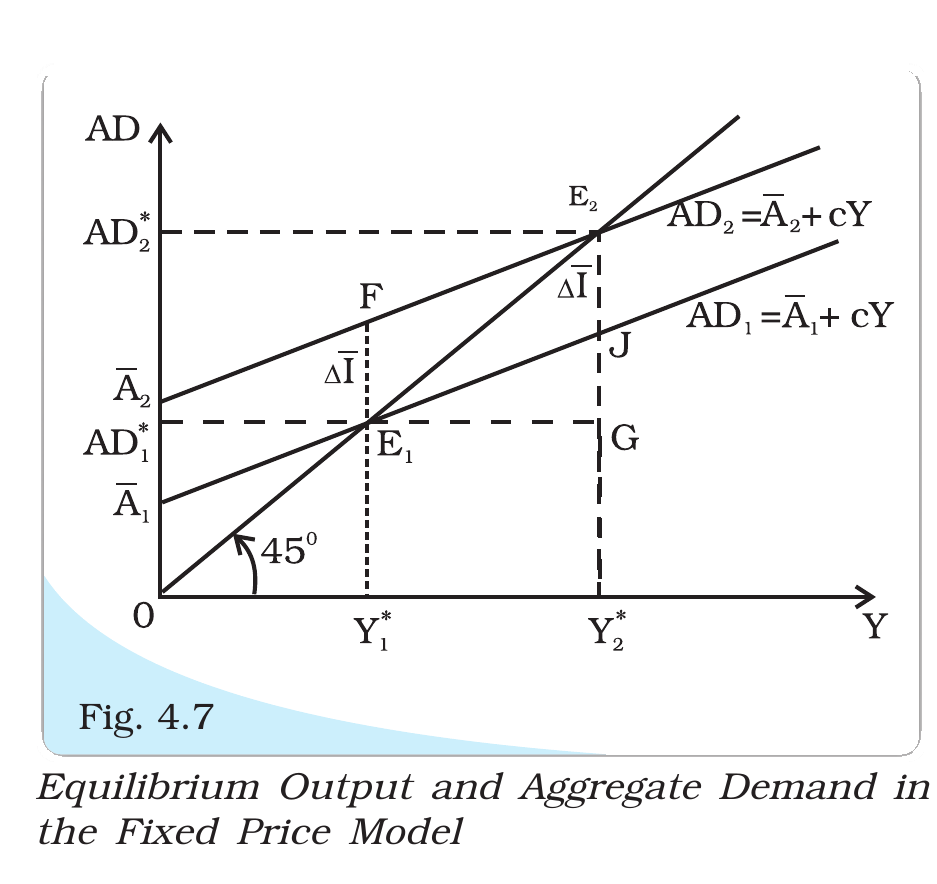
In \( AD=\overline{C}+\overline{I}+CY \), the C in CY is c, the marginal propensity to consume. The term \( \overline{C} \) is autonomous consumption: the consumption that takes place even at zero income. A change in it moves the AD line up or down by the same amount at every income. Equilibrium income is where the AD line meets the 45° line, so it changes too.
(A) Change in equilibrium level of income — Correct. The shifted AD line meets the 45° line at a new point. Through the multiplier, income changes by more than the change in autonomous consumption.
(B) Change in aggregate demand — Correct. \( \overline{C} \) is a part of AD. So AD changes by the same amount at every level of income.
(C) Change in Investment — Incorrect. Investment \( \overline{I} \) is also autonomous and is given on its own. A change in consumption does not alter it.
(D) Change in aggregate demand and no change in equilibrium level of income — Incorrect. The first half is true, but equilibrium income does change, as statement (A) shows.
(E) Change in marginal propensity to consume — Incorrect. The marginal propensity to consume (c) is the slope of the AD line. A change in autonomous consumption shifts the line but keeps its slope.
NCERT (2026-27): “4.3.2 Effect of an Autonomous Change in Aggregate Demand on Income and Output We have seen that the equilibrium level of income depends on aggregate demand. Thus, if aggregate demand changes, the equilibrium level of income changes. … When autonomous investment increases, the AD1 line shifts in parallel upwards and assumes the position AD2.… …When A̅ changes the line shifts upwards or downwards in parallel. When c changes, however, the line swings up or down.…”
|