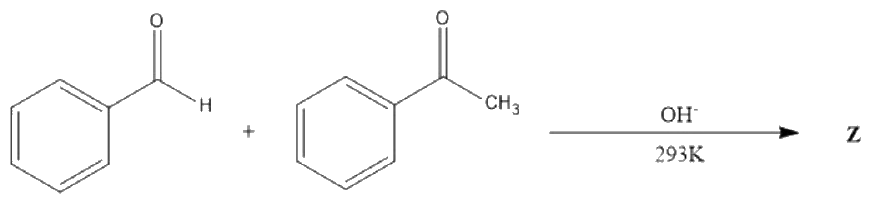
The major product Z in the following chemical reaction is
Answer & explanation
Correct answer: option 1
The correct answer is Option (1) → 1,3-diphenylprop-2-en-1-one (benzalacetophenone)
Carbonyl compounds react with alkali in different ways, depending on whether they have an α-hydrogen (an H on the carbon next to the C=O group):
Aldol condensation: two molecules of an aldehyde or ketone with α-H join in dilute alkali to give a β-hydroxy carbonyl compound. This loses water to give an α,β-unsaturated carbonyl compound.
Cross aldol (Claisen–Schmidt) condensation: an aromatic aldehyde without α-H reacts with an aldehyde or ketone that has α-H. Only the second one can form the carbanion (enolate), and it attacks the C=O of the aldehyde.
Cannizzaro reaction: an aldehyde without α-H on its own, with concentrated alkali, gives an alcohol and the salt of a carboxylic acid.
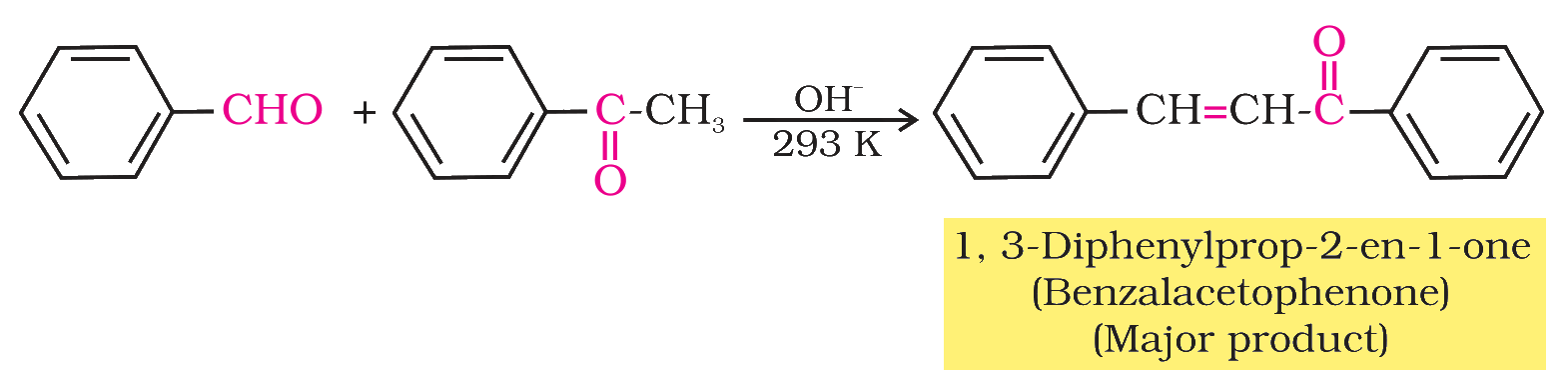
Here benzaldehyde has no α-H, and acetophenone has three α-H atoms on its CH3 group. So they undergo the Claisen–Schmidt condensation. The hydroxide ion removes an α-H from acetophenone, and the carbanion formed adds to the C=O of benzaldehyde:
\( \displaystyle \ce{C6H5CHO + CH3COC6H5} \xrightarrow[293\ \mathrm{K}]{\ce{OH^-}} \ce{C6H5-CH(OH)-CH2-CO-C6H5} \)
The β-hydroxy ketone loses water at once, because the new C=C bond is conjugated with both the C=O group and the benzene ring:
\( \displaystyle \ce{C6H5-CH(OH)-CH2-CO-C6H5} \xrightarrow{-\ce{H2O}} \ce{C6H5-CH=CH-CO-C6H5} \)
So Z is 1,3-diphenylprop-2-en-1-one (benzalacetophenone), C6H5–CH=CH–CO–C6H5. It is formed as the more stable trans (E) isomer, in which the two bulky groups on the C=C bond are on opposite sides.
Why the other options are incorrect
Option (2) benzil (1,2-diphenylethane-1,2-dione) — Incorrect. A 1,2-diketone is an oxidation product (for example, of benzoin). It has only the two C6H5–CO units and no CH=CH unit from a condensation.
Option (3) 1,3-diphenylprop-2-en-1-ol — Incorrect. It has the right carbon skeleton, but an –OH group in place of the C=O group. That would need reduction of the ketone, and alkali does not reduce it.
Option (4) 1,2-diphenylethane-1,2-diol — Incorrect. It is made of two C6H5–CH(OH) units, both from benzaldehyde, joined by reductive coupling. It has no carbon atoms from acetophenone.
Note: It seems that there is a mistake in the original NTA paper, which draws Option (1) as the cis (Z) isomer when the product of the Claisen–Schmidt reaction is the trans (E) chalcone.
NCERT (2026-27 edition):
Reactions due to α-hydrogen – “(ii) Cross aldol condensation: When aldol condensation is carried out between two different aldehydes and / or ketones, it is called cross aldol condensation. If both of them contain α-hydrogen atoms, it gives a mixture of four products. This is illustrated below by aldol reaction of a mixture of ethanal and propanal. …
Ketones can also be used as one component in the cross aldol reactions.”