
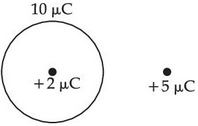
A thin metallic spherical shell contains a charge +10 \( \mu \)C on it. A point charge +2 \( \mu \)C is placed at the centre of the shell and another charge +5 \( \mu \)C is placed outside it as shown. The force on the charge +2 \( \mu \)C at the centre is:
Answer & explanation
Correct answer: option 4
The correct answer is Option (4) → zero
A hollow conductor gives electrostatic shielding: charges outside the cavity (on the outer surface of the shell and beyond it) produce no electric field inside the cavity.
The +2 \( \mu \)C charge at the centre induces \( -2\,\mu\mathrm{C} \) on the inner surface of the shell and the outer surface carries \( 10 + 2 = 12\,\mu\mathrm{C} \).
The inner surface charge is spread uniformly, because the charge inside is at the centre; a uniform spherical layer of charge gives zero field at its centre.
The outer surface charge (made non-uniform by the +5 \( \mu \)C charge) and the +5 \( \mu \)C charge together give zero field everywhere inside the conductor and its cavity.
So the field at the centre is zero, and the force on the +2 \( \mu \)C charge is zero.
NCERT (2026-27):
Electrostatics of Conductors – “… Whatever be the charge and field configuration outside, any cavity in a conductor remains shielded from outside electric influence: the field inside the cavity is always zero. This is known as electrostatic shielding.”