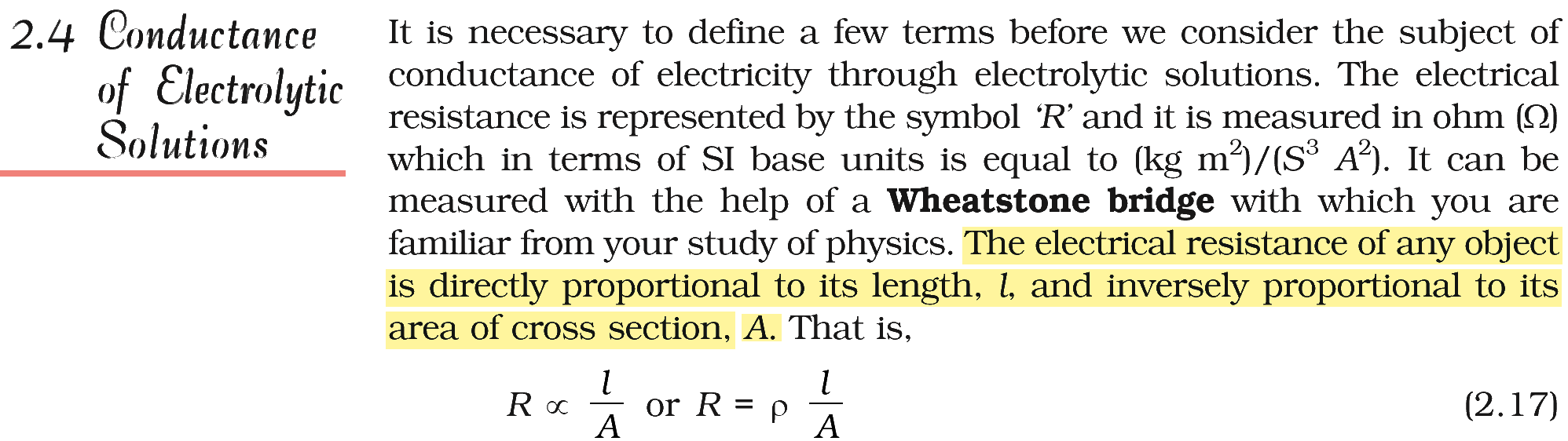
The increasing order of the electrical resistance of the copper wires A, B, C and D will be
(A) Copper wire A: diameter 1 cm, length 50 cm
(B) Copper wire B: diameter 2 cm, length 50 cm
(C) Copper wire C: diameter 1 cm, length 100 cm
(D) Copper wire D: diameter 2 cm, length 100 cm
Conductivity of copper is 5.9 × 10³ S m-1
Choose the correct answer from the options given below:
Answer & explanation
Correct answer: option 2
The correct answer is Option (2) → (B), (D), (A), (C)
The resistance of a wire depends on its length (l), its area of cross section (A) and the material it is made of. The material enters through its resistivity (ρ), which is the reciprocal of its conductivity (κ):
\( \displaystyle R=\rho\,\frac{l}{A}=\frac{1}{\kappa}\times\frac{l}{A} \)
Length: a longer wire has a higher resistance (R ∝ l).
Thickness: a thicker wire has a lower resistance. For a round wire of diameter d, the area is πd2/4, so doubling the diameter makes the area four times larger.
\( \displaystyle R=\frac{1}{\kappa}\times\frac{4\,l}{\pi d^2}\quad\Rightarrow\quad R\propto\frac{l}{d^2} \)
All four wires are copper, so κ is the same for all of them and the order is decided by l/d2 alone (l in cm, d in cm):
(B) Copper wire B: 50/22 = 12.5
(D) Copper wire D: 100/22 = 25
(A) Copper wire A: 50/12 = 50
(C) Copper wire C: 100/12 = 100
Shortcut: Wire B is the shortest and thickest, so its resistance is the lowest; wire C is the longest and thinnest, so its resistance is the highest. Options (2) and (3) both start with (B) and end with (C). Doubling the diameter lowers the resistance four times, but doubling the length raises it only two times, so D is lower than A, and only Option (2) remains.
NCERT (2026-27 edition):
Conductance of Electrolytic Solutions