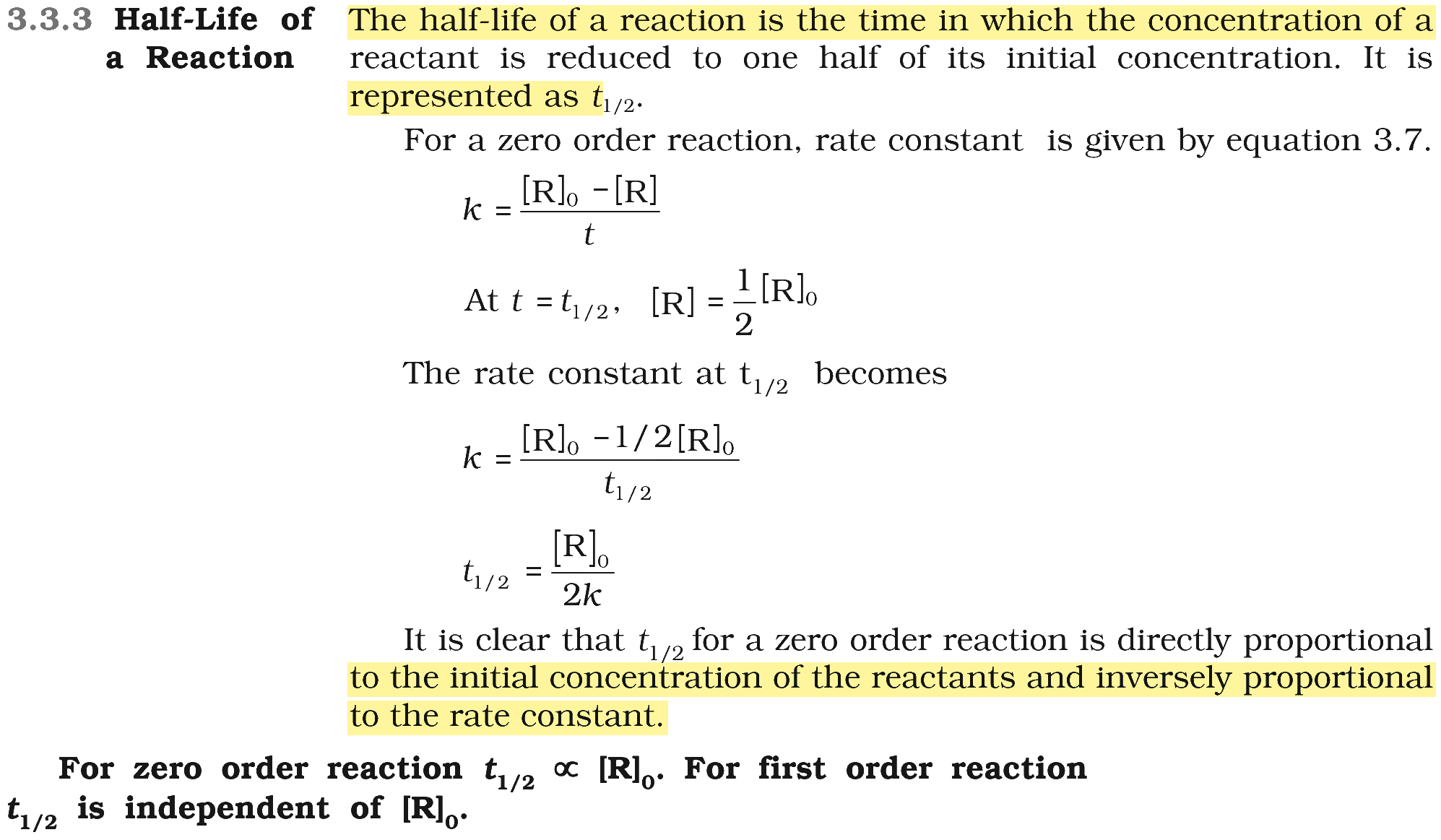
The half-life of a reaction is the time in which the concentration of a reactant is reduced to one half of its initial concentration. Which of the following statements are correct?
(A) It is represented as t1/2.
(B) For a first order reaction, it is independent of the initial concentration of the reactant.
(C) The SI unit of half-life is second.
(D) For a zero-order reaction it is inversely proportional to the rate constant.
Choose the correct answer from the options given below:
Answer & explanation
Correct answer: option 1
The correct answer is Option (1) → (A), (B), (C) and (D)
The half-life of a reaction depends on its order. Putting [R] = [R]0/2 into the integrated rate equations gives:
\( \displaystyle \text{Zero order: }[R]=[R]_0-kt \quad\Rightarrow\quad t_{1/2}=\frac{[R]_0}{2k} \)
\( \displaystyle \text{First order: }k=\frac{2.303}{t}\log\frac{[R]_0}{[R]} \quad\Rightarrow\quad t_{1/2}=\frac{2.303\log2}{k}=\frac{0.693}{k} \)
(A) It is represented as t1/2. Correct. Half-life is written t1/2, the time for half of the reactant to be used up.
(B) For a first order reaction, it is independent of the initial concentration of the reactant. Correct. t1/2 = 0.693/k contains no concentration term, so it is the same whatever the starting concentration.
(C) The SI unit of half-life is second. Correct. Half-life is a time, and the SI unit of time is the second.
(D) For a zero-order reaction it is inversely proportional to the rate constant. Correct. t1/2 = [R]0/2k, so for a given initial concentration, t1/2 is proportional to 1/k.
NCERT (2026-27 edition):
Half-Life of a Reaction