
Case: Read the passage and answer the question.
Consider a coil C1 connected to a galvanometer G, as shown. A bar magnet is placed near the coil with its north pole facing the coil and its south pole away from the coil. The magnet is then moved towards the coil.
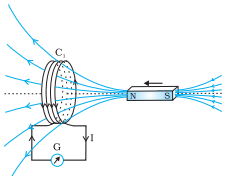
What happens when the south pole of a bar magnet is brought close to the coil?
Answer & explanation
Correct answer: option 4
The correct answer is Option (4) → All of the above
By Faraday’s law, an emf is induced in a coil whenever the magnetic flux through it changes. Bringing either pole of a magnet towards the coil changes this flux. So the south pole acts like the north pole, and only the direction of the induced current is reversed.
Option (1) An electric current is produced. — Incorrect. This statement is true. But it is only part of the answer.
Option (2) An emf is induced in the coil. — Incorrect. This is also true. It too gives just one of the effects.
Option (3) The galvanometer needle shows a deflection. — Incorrect. This happens as well, so choosing it alone leaves out the other two.
Option (4) All of the above — Correct. All three statements hold:
The coil and the galvanometer form a closed circuit. So the induced emf drives an induced current round it, and (1) holds.
As the south pole moves towards the coil, the flux through the coil changes. So an emf is induced in it, and (2) holds.
The induced current passes through the galvanometer and deflects the needle for as long as the magnet moves, so (3) holds. The deflection is opposite to that for the north pole moved the same way.
NCERT (2026-27):
The Experiments of Faraday and Henry – “… When the North-pole of a bar magnet is pushed towards the coil, the pointer in the galvanometer deflects, indicating the presence of electric current in the coil. The deflection lasts as long as the bar magnet is in motion. … Moreover, when the South-pole of the bar magnet is moved towards or away from the coil, the deflections in the galvanometer are opposite to that observed with the North-pole for similar movements.”
Faraday’s Law of Induction – “The magnitude of the induced emf in a circuit is equal to the time rate of change of magnetic flux through the circuit.”