Match List-I with List-II
| List-I | List-II | ||
|---|---|---|---|
| (A) | Amalgamation of partnership firms | (I) | Meaning of Goodwill |
| (B) | Nature of Business | (II) | Treatment of goodwill |
| (C) | The present value of a firm's anticipated excess earnings | (III) | Factor affecting goodwill |
| (D) | When the new Partner brings goodwill in cash | (IV) | Need for valuation of goodwill |
Choose the correct answer from the options given below:
Answer & explanation
Correct answer: option 1
The correct answer is Option (1) → (A) - (IV), (B) - (III), (C) - (I), (D) - (II)
Each List-I item is one part of the topic of goodwill: its meaning, what affects its value, when it must be valued, and how it is recorded.
(A) Amalgamation of partnership firms — this matches (IV) Need for valuation of goodwill. When two firms merge, each side’s goodwill must be valued so that the partners are paid fairly for what they bring in.
(B) Nature of Business — this matches (III) Factor affecting goodwill. A firm with high value-added products or a stable demand earns more profit and so has more goodwill.
(C) The present value of a firm’s anticipated excess earnings — this matches (I) Meaning of Goodwill. Goodwill exists only where a firm is expected to earn more than the normal profit.
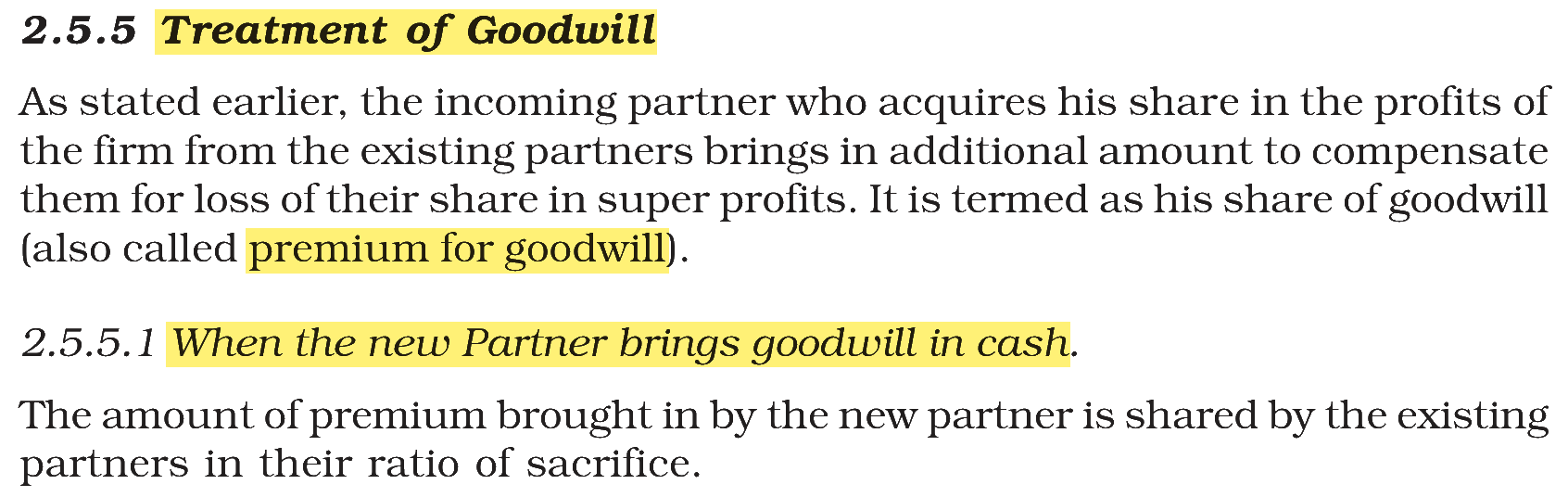
(D) When the new Partner brings goodwill in cash — this matches (II) Treatment of goodwill. How the premium is recorded and shared among the old partners in their sacrificing ratio is its accounting treatment.
NCERT (2026-27 edition): NCERT (2026-27 edition): NCERT (2026-27 edition): NCERT (2026-27 edition):
|