
Statement I: \(\Lambda_m\) of a weak electrolyte shows a sharp increase when the solution is diluted.
Statement II: The degree of dissociation of a weak electrolyte increases with dilution of the solution.
Answer & explanation
Correct answer: option 1
The correct answer is Option (1) → Both Statement I and Statement II are correct and Statement II is the correct explanation of Statement I
Molar conductivity, Λm, is the conductance of the volume of solution that contains 1 mol of the electrolyte. It rises when the number of ions coming from that 1 mol rises. A weak electrolyte such as acetic acid is only partly dissociated:
\( \displaystyle \ce{CH3COOH <=> CH3COO^- + H^+} \)
Statement I: \( \Lambda_m \) of a weak electrolyte shows a sharp increase when the solution is diluted. — True. On dilution Λm of a weak electrolyte increases steeply, especially at low concentrations, unlike the small, gradual rise for a strong electrolyte.
Statement II: The degree of dissociation of a weak electrolyte increases with dilution of the solution. — True. A weak electrolyte has a lower degree of dissociation at higher concentration; diluting it shifts the equilibrium towards the ions, so α increases.
Why Statement II explains Statement I?
Statement I is about how Λm changes with dilution; Statement II is about how much of the electrolyte breaks into ions.
As α increases, the 1 mol of electrolyte gives many more ions, and that is why Λm rises so sharply. So Statement II is the cause of Statement I.
NCERT (2026-27 edition):
Weak Electrolytes – “Weak electrolytes like acetic acid have lower degree of dissociation at higher concentrations and hence for such electrolytes, the change in Λm with dilution is due to increase in the degree of dissociation and consequently the number of ions in total volume of solution that contains 1 mol of electrolyte. In such cases Λm increases steeply (Fig. 2.6) on dilution, especially near lower concentrations.”
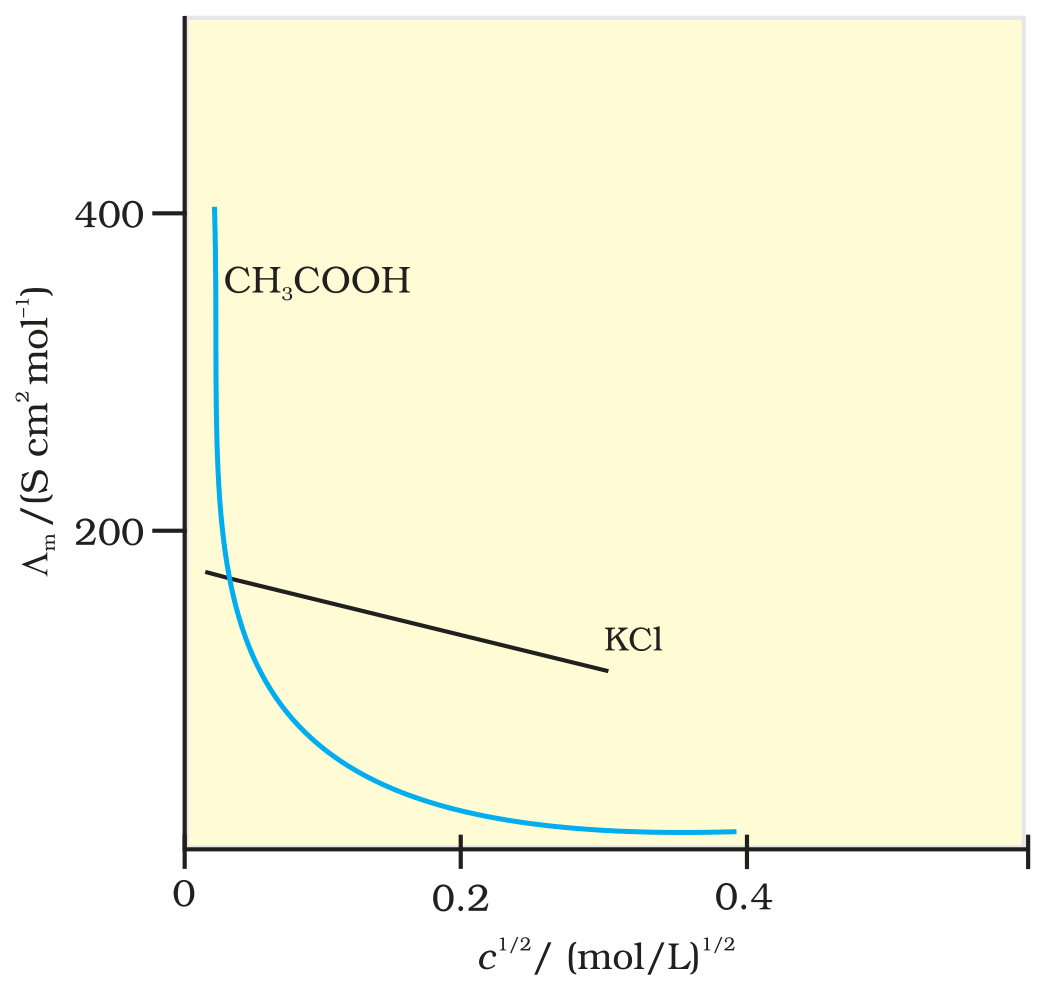
Fig. 2.6: Molar conductivity versus c½ for acetic acid (weak electrolyte) and potassium chloride (strong electrolyte) in aqueous solutions.