
If the sum of the lengths of the hypotenuse and a side of a right-angled triangle is given, the area of the triangle is maximum when the angle between them is:
Answer & explanation
Correct answer: option 1
The correct answer is Option (1) → $\frac{\pi}{3}$
Let ABC be a right-angled triangle at B.
Let hypotenuse $AC = l$ and side $AB = x$, then
$BC^2 = l^2-x^2⇒ BC= \sqrt{l^2-x^2}$ ...(i)
Given $l + x = k$ (fixed)
$⇒l=k-x$ ...(ii)
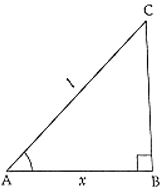
Let A be area of ΔABC, then
$A=\frac{1}{2}AB×BC$
$⇒\frac{1}{2}x\sqrt{l^2-x^2}$ (using (i))
$⇒\frac{1}{2}x\sqrt{(k-x)^2-x^2}$ (using (ii))
$⇒A^2=\frac{1}{4}x^2(k^2-2kx)=\frac{1}{4}(k^2x^2-2kx^3)$.
Now A is maximum when $A^2$ is maximum. Let us write $A^2$ as $f(x)$,
so $f(x)=\frac{1}{4}(k^2x^2-2kx^3)$
$⇒f'(x)=\frac{1}{4}(2k^2x-6kx^2)$ and $f''(x)=\frac{1}{4}((2k^2-12kx)$.
Now $f'(x)=0⇒2k^2x-6kx^2=0⇒x=\frac{k}{3}$ $(∵x>0)$
$f''(\frac{k}{3})=\frac{1}{4}(2k^2-4k^2)=-\frac{1}{2}k^2<0$
⇒ f(x) is maximum when $x=\frac{k}{3}$ ⇒ A is maximum when $x=\frac{k}{3}$.
From (ii), when $x=\frac{k}{3},l=k-\frac{k}{3}=\frac{2k}{3}$
From a right angled triangle ABC, $\cos A=\frac{x}{l}=\frac{\frac{k}{3}}{\frac{2k}{3}}=\frac{1}{2}⇒A=\frac{\pi}{3}$