Internal acid base reaction of amino acids is due to formation of
Answer & explanation
Correct answer: option 1
The correct answer is Option (1) → Zwitter ion
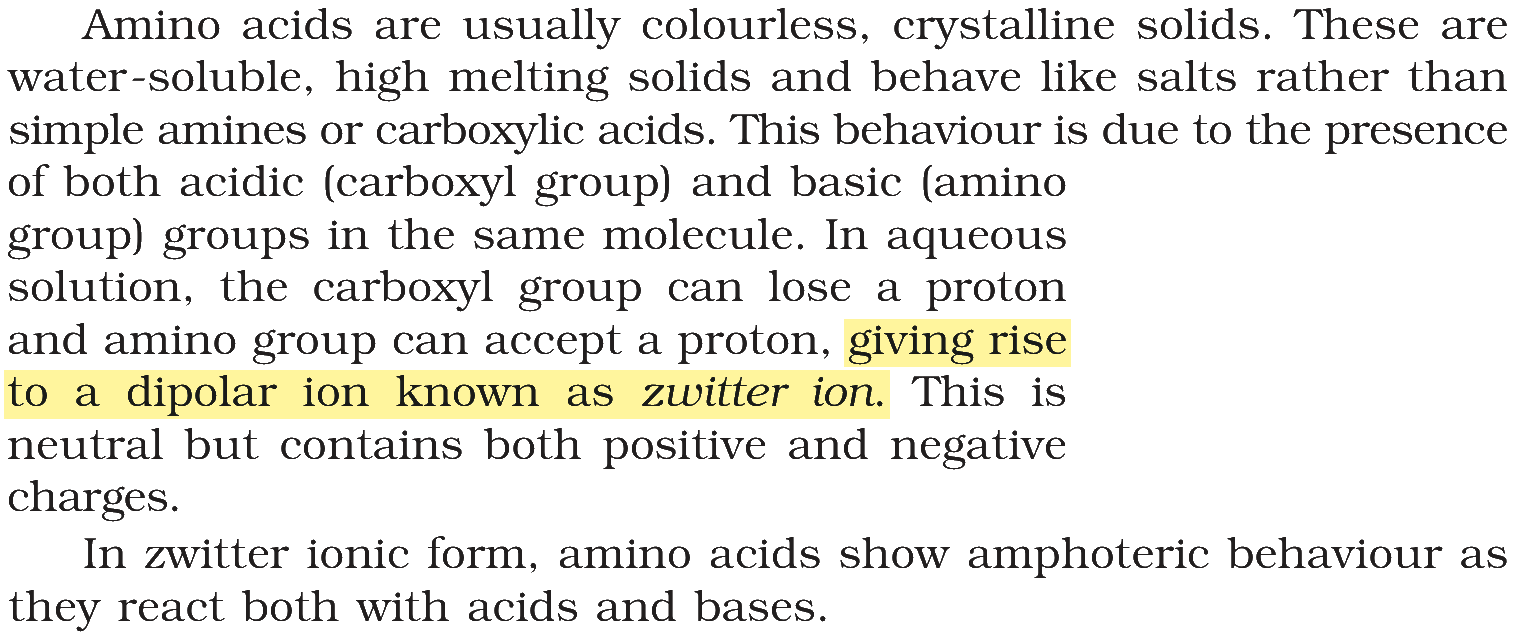
An α-amino acid carries an acidic carboxyl group and a basic amino group in the same molecule. The carboxyl group can lose a proton and the amino group can accept it, so a proton moves from one end of the molecule to the other. This internal acid–base reaction gives a dipolar ion, the zwitter ion:
\( \displaystyle \ce{H2N-CH(R)-COOH <=> H3N^+-CH(R)-COO^-} \)
The zwitter ion is electrically neutral as a whole but carries both a positive and a negative charge.
Why the other options are incorrect
Option (2) A lactam — Incorrect. A lactam is a cyclic amide, formed when the amino and carboxyl groups of the same molecule condense with loss of water; this needs the groups far enough apart to close a five- or six-membered ring and is not an acid–base reaction.
Option (3) An amide — Incorrect. An amide, \( \ce{-CONH-} \), forms by condensation of an acid group with an amine group, with loss of water; no water is lost in the zwitter ion.
Option (4) A peptide — Incorrect. A peptide bond forms between the \( \ce{-COOH} \) of one amino acid and the \( \ce{-NH2} \) of another, with loss of water: \( \ce{H2N-CH2-COOH + H2N-CH(CH3)-COOH -> H2N-CH2-CONH-CH(CH3)-COOH + H2O} \).
NCERT (2026-27 edition):
Classification of Amino Acids – …