CUETMOCK
  • Pricing
  • Mentors
Log inStart freeStart free mocks→

First test, then trust

Try a free CUET mock test.

Join 5,00,000+ students who rehearsed exam day on the exact NTA screen before sitting CUET. On the web and on Android.

Start free mocks →Get the Android app
CUETMOCK

India's #1 CUET Mock Test Platform. Original NCERT-based questions on the exact NTA exam screen — trusted by 5,00,000+ students since CUET 2022.

Get it onGoogle PlayScan to download the CUETMOCK app

Mock tests

  • CUET mock test series
  • Browse all papers
  • Commerce mocks
  • Humanities (Arts) mocks
  • Science mocks
  • Languages & GAT mocks
  • Free practice questions
  • Pricing

Resources

  • CUET exam guide
  • CUET syllabus
  • Universities accepting CUET
  • Expert blogs
  • News & notifications
  • Webinars & counselling
  • CUET score calculator
  • How we estimate your rank
  • FAQs

Company

  • About us
  • Our leadership & team
  • Our toppers
  • Mentors
  • For schools
  • Contact us
  • Terms
  • Privacy
  • Refund policy

Talk to us

+91 7696 6630 56info@cuetmock.comWhatsApp us

Our other platforms

  • JEE Mock — For IIT-JEE aspirants
  • NEET Mock — For NEET aspirants

Newsletter

Exam updates, study material and offers — no spam.

© 2026 NYC Ventures Pvt. Ltd.

701-702, Royal Business Park, Zirakpur, Punjab - 140603

  • Terms of use
  • Privacy policy
  • Refund policy
  • Contact us

iCUETMOCK is an independent preparation platform, not affiliated with the National Testing Agency (NTA). Always check exam details on the official NTA website.

  • Home
  • Mock tests
  • CUET guide
  • Pricing
  • Log in
Home/Practice questions/History
HistoryAncient India: Kings, Farmers and Towns

Match List-I with List-II:List-IRulerList-IIDynasty(A) Asoka(I) Maury…

Match List-I with List-II:

List-I
Ruler
List-II
Dynasty
(A) Asoka(I) Maurya
(B) Kanishka(II) Gupta
(C) Samudragupta(III) Kushana
(D) Rudradaman(IV) Shaka

Choose the correct answer from the options given below:

Answer & explanation+

Correct answer: option 2

The correct answer is Option (2) → (A)-(I), (B)-(III), (C)-(II), (D)-(IV)

(A) Asoka — this matches (I) Maurya. Asoka was the grandson of Chandragupta Maurya, who founded the Mauryan Empire (c. 321 BCE), and he conquered Kalinga.

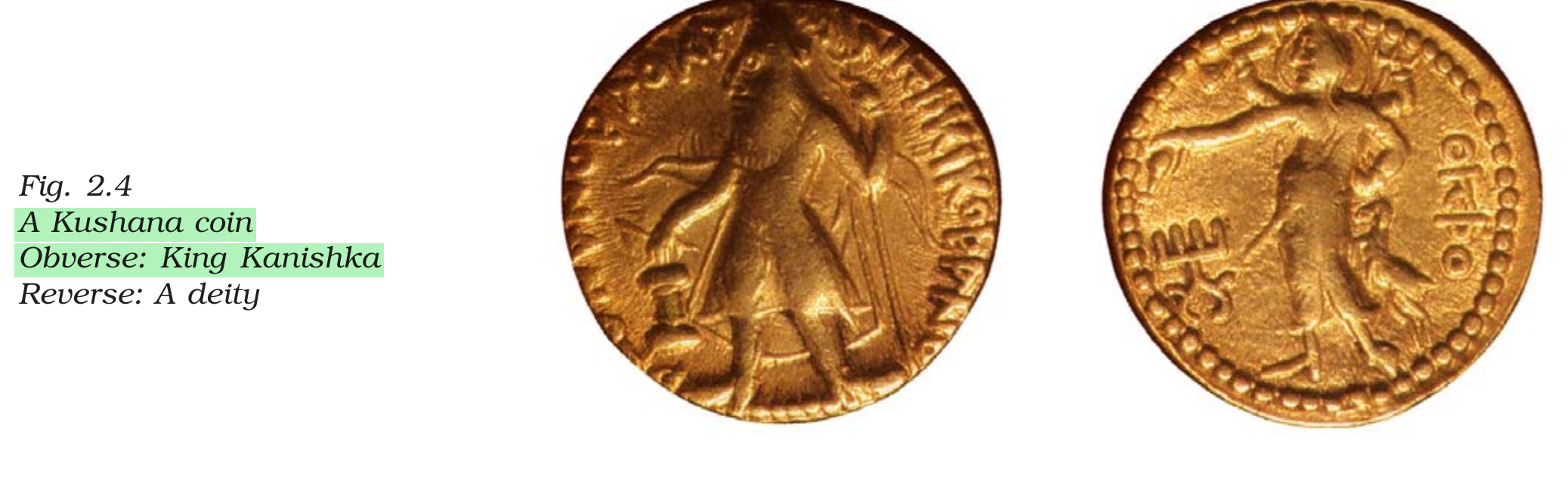
(B) Kanishka — this matches (III) Kushana. King Kanishka appears on a Kushana coin; the Kushanas ruled over a vast kingdom from Central Asia to northwest India.

(C) Samudragupta — this matches (II) Gupta. Samudragupta was arguably the most powerful of the Gupta rulers (c. fourth century CE), praised in the Prayaga Prashasti.

(D) Rudradaman — this matches (IV) Shaka. A rock inscription of the second century CE records the achievements of the Shaka ruler Rudradaman, who had the Sudarshana lake repaired.


NCERT (2026-27): “3. An Early Empire … The growth of Magadha culminated in the emergence of the Mauryan Empire. Chandragupta Maurya, who founded the empire (c. 321 BCE), extended control as far northwest as Afghanistan and Baluchistan, and his grandson Asoka, arguably the most famous ruler of early India, conquered Kalinga (present-day coastal Orissa).…

4.2 Divine kings … One means of claiming high status was to identify with a variety of deities. This strategy is best exemplified by the Kushanas (c. first century BCE first century CE), who ruled over a vast kingdom extending from Central Asia to northwest India. Their history has been reconstructed from inscriptions and textual traditions. The notions of kingship they wished to project are perhaps best evidenced in their coins and sculpture.…

4.2 Divine kings … The Prayaga Prashasti (also known as the Allahabad Pillar Inscription) composed in Sanskrit by Harishena, the court poet of Samudragupta, arguably the most powerful of the Gupta rulers (c. fourth century CE), is a case in point.…

3.2 Non-Kshatriya kings … However, one of the earliest inscriptions in Sanskrit describes how Rudradaman, the best-known Shaka ruler (c. second century CE ), rebuilt Sudarshana lake (Chapter 2). This suggests that powerful mlechchhas were familiar with Sanskritic traditions.…”

NCERT extract

Advertisement

Practise more on Ancient India: Kings, Farmers and Towns

Chapter-wise mocks on the real NTA exam screen, with solutions and your rank. Your first mocks are free.

Start free mocks →

Advertisement

Next questions

  1. Which of the following historian has talked about role of rumours in the making of Mahatma Gandhi?History · Modern India: Mahatma Gandhi and the Nationalist movement
  2. युवा पीढ़ी के पथ-भ्रष्ट होने का क्या कारण दर्शाया गया है-Hindi · Comprehension - (Narrative / Factual)
  3. Kabir joins classmates who favour a ban on mobile phones in school. Match List-I with List-II.List-IList-II(A) He finds people having views…Psychology · Social Influence and Group Processes
  4. Which answer figure will complete the pattern in the following question figure?General Aptitude Test · Verbal Reasoning
  5. A and B started their journeys from X to Y and Y to X, respectively. After crossing each other, A and B completed remaining parts of their…General Aptitude Test · Numerical Ability
  6. A glass prism of refractive index 1.56 is immersed in water (R.I. = 4/3). The beam of light incident normally on the face AB is totally ref…Physics · Ray Optics
  7. In the following question, out of the given four alternatives, select the alternative which best expresses the meaning of the Idiom/Phrase.…English · Grammar: Idioms
  8. If cotA= 15/8 find the value of tan2A.General Aptitude Test · Quantitative Reasoning
  9. "An instrument that helps to mobilise large amounts of money in short period by commercial banks". Identify the money market instrument sta…Business Studies · Financial Markets
  10. Which of the following statements is incorrect about England?Statement A- In the sixteenth century, the state in England was run by a pries…Political Science · Secularism