
In a pure semiconductor, a hole appears to move from one site to another because
Answer & explanation
Correct answer: option 1
The correct answer is Option (1) → an electron from a neighbouring covalent bond jumps into the vacant site
Option (1) an electron from a neighbouring covalent bond jumps into the vacant site — Correct. The jumping electron fills the old vacancy and leaves a new one in the bond it came from. So the hole appears to shift from one site to the next. Only bound electrons have moved.
Option (2) the free electron that left the bond keeps returning to nearby bonds — Incorrect. The electron set free when the bond broke moves on its own as a conduction electron. It takes no part in the motion of the hole.
Option (3) the positively charged atom at the vacant site moves through the lattice — Incorrect. The atoms stay at their lattice sites. Only the vacancy passes from one bond to another.
Option (4) a positive particle is set free when the covalent bond breaks — Incorrect. Breaking a bond frees an electron and leaves a vacancy behind. This vacancy acts as a hole with an effective positive charge. No positive particle is released.
NCERT (2026-27):
Intrinsic Semiconductor – “Semiconductors posses the unique property in which, apart from electrons, the holes also move. Suppose there is a hole at site 1 as shown in Fig. 14.5(a). The movement of holes can be visualised as shown in Fig. 14.5(b). An electron from the covalent bond at site 2 may jump to the vacant site 1 (hole). Thus, after such a jump, the hole is at site 2 and the site 1 has now an electron. Therefore, apparently, the hole has moved from site 1 to site 2. Note that the electron originally set free [Fig. 14.5(a)] is not involved in this process of hole motion. … Remember that the motion of hole is only a convenient way of describing the actual motion of bound electrons, whenever there is an empty bond anywhere in the crystal.”
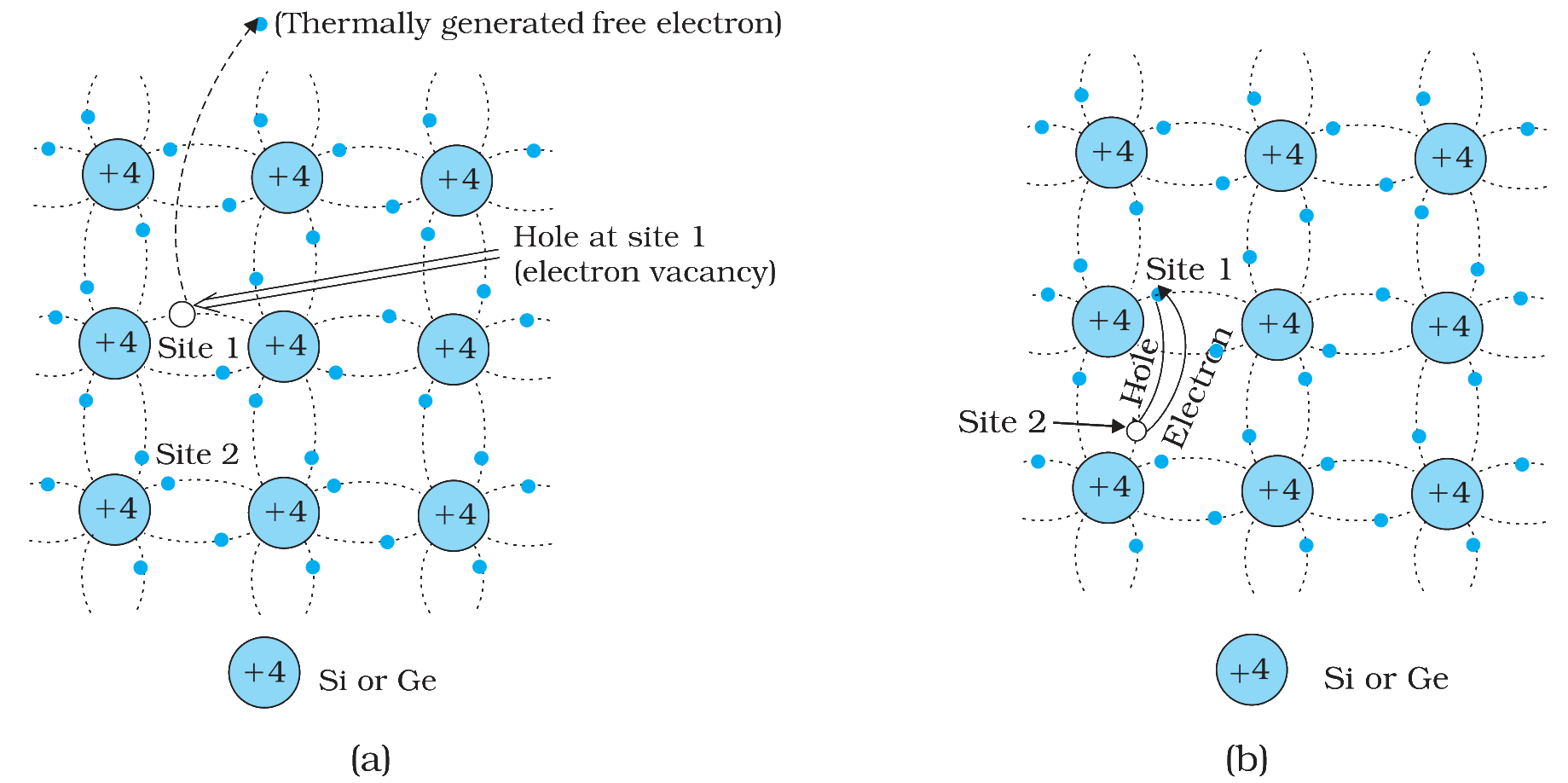
Fig. 14.5: (a) Schematic model of generation of hole at site 1 and conduction electron due to thermal energy at moderate temperatures. (b) Simplified representation of possible thermal motion of a hole. The electron from the lower left hand covalent bond (site 2) goes to the earlier hole site1, leaving a hole at its site indicating an apparent movement of the hole from site 1 to site 2.