CUETMOCK
  • Pricing
  • Mentors
Log inStart freeStart free mocks→

First test, then trust

Try a free CUET mock test.

Join 5,00,000+ students who rehearsed exam day on the exact NTA screen before sitting CUET. On the web and on Android.

Start free mocks →Get the Android app
CUETMOCK

India's #1 CUET Mock Test Platform. Original NCERT-based questions on the exact NTA exam screen — trusted by 5,00,000+ students since CUET 2022.

Get it onGoogle PlayScan to download the CUETMOCK app

Mock tests

  • CUET mock test series
  • Commerce mocks
  • Humanities (Arts) mocks
  • Science mocks
  • Languages & GAT mocks
  • Free practice questions
  • Pricing

Resources

  • CUET exam guide
  • CUET syllabus
  • Universities accepting CUET
  • Expert blogs
  • News & notifications
  • Webinars & counselling
  • CUET score calculator
  • How we estimate your rank
  • FAQs

Company

  • About us
  • Our leadership & team
  • Our toppers
  • Mentors
  • For schools
  • Contact us
  • Terms
  • Privacy
  • Refund policy

Talk to us

+91 7696 6630 56info@cuetmock.comWhatsApp us

Our other platforms

  • JEE Mock — For IIT-JEE aspirants
  • NEET Mock — For NEET aspirants

Newsletter

Exam updates, study material and offers — no spam.

© 2026 NYC Ventures Pvt. Ltd.

701-702, Royal Business Park, Zirakpur, Punjab - 140603

  • Terms of use
  • Privacy policy
  • Refund policy
  • Contact us

iCUETMOCK is an independent preparation platform, not affiliated with the National Testing Agency (NTA). Always check exam details on the official NTA website.

  • Home
  • Mock tests
  • CUET guide
  • Pricing
  • Log in
Home/Practice questions/History
HistoryModern India: Colonial cities

Which of the following poets witnessed the Revolt of 1857 in Delhi?

Which of the following poets witnessed the Revolt of 1857 in Delhi?

Answer & explanation+

Correct answer: option 2

The correct answer is Option (2) → Mirza Ghalib

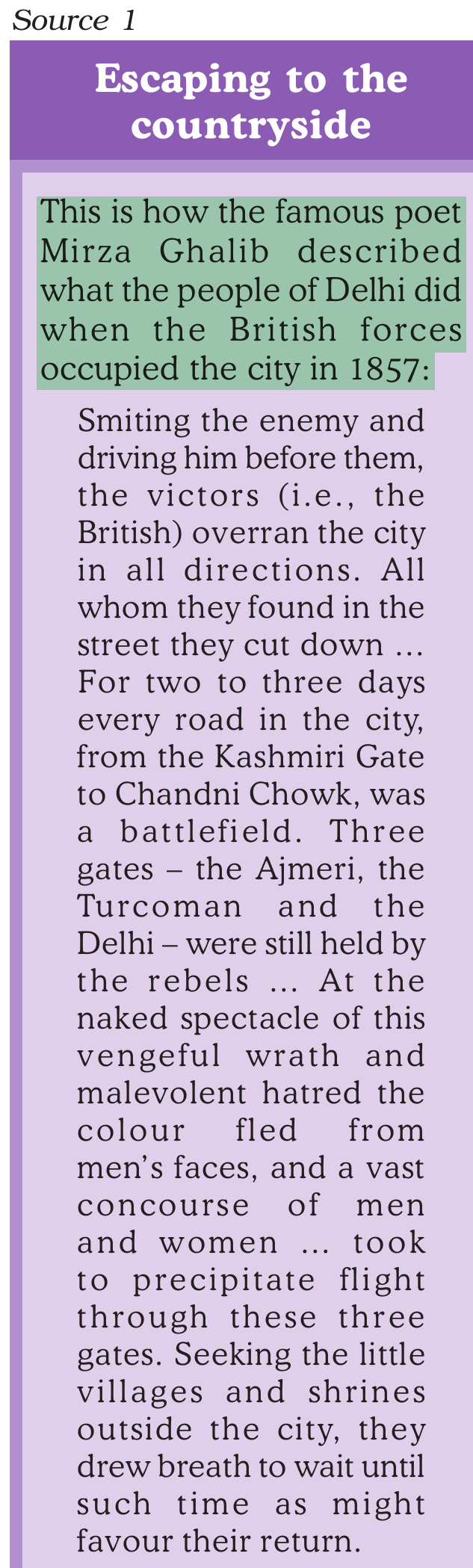
The famous poet Mirza Ghalib described what the people of Delhi did when the British forces occupied the city in 1857.

Note: This question is taken from the chapter ‘Colonial Cities’ which was there in the pre-rationalised NCERT and has been deleted from subsequent editions of NCERT, including the NCERT book (2026-27).


NCERT: Themes in Indian History Part III — Chapter 12: Colonial Cities (Pre-rationalised)

NCERT extract

Advertisement

Practise more on Modern India: Colonial cities

Chapter-wise mocks on the real NTA exam screen, with solutions and your rank. Your first mocks are free.

Start free mocks →

Advertisement

Next questions

  1. Select the most appropriate meaning of the given idiom. Someone's heart is in the right placeEnglish · Grammar: Idioms
  2. The formal British rule in India is understood to have commenced in 1757, after the Battle of ______.General Aptitude Test · General Knowledge
  3. The solution of the differential equation displaystyledy/dx=(3e^2x+3e^4x)/(e^x+e^-x) is:Maths. Section A · Differential Equations (Section A)
  4. Assertion: We have lost all the direct evidence of origin of life. Reason: The persons responsible for protecting evidences were not skille…Biology · Evolution
  5. If a=(√5+2)/(√5-2) and b=(√5-2)/(√5+2), then the value of 2a^2 + 2b^2 - 5ab is equal to :General Aptitude Test · Quantitative Reasoning
  6. Sociology can help you to map the link between which of the following?Sociology · Indian Society: Introducing Indian Society
  7. When temperature changes from 293 K to 313 K, the rate of reactionChemistry · Physical: Chemical Kinetics
  8. When a wave undergoes reflection from a denser medium, by how much does its phase change ?Physics · Wave Optics
  9. The index of prices of a given basket of commodities which are bought by the representative consumer is known as:Economics · Macro Economics: National Income Accounting
  10. Given a cash reserve ratio of 50 per cent and reserves of Rs 100, what is the money multiplier?Economics · Macro Economics: Money and Banking