CUETMOCK
  • Pricing
  • Mentors
Log inStart freeStart free mocks→

First test, then trust

Try a free CUET mock test.

Join 5,00,000+ students who rehearsed exam day on the exact NTA screen before sitting CUET. On the web and on Android.

Start free mocks →Get the Android app
CUETMOCK

India's #1 CUET Mock Test Platform. Original NCERT-based questions on the exact NTA exam screen — trusted by 5,00,000+ students since CUET 2022.

Get it onGoogle PlayScan to download the CUETMOCK app

Mock tests

  • CUET mock test series
  • Commerce mocks
  • Humanities (Arts) mocks
  • Science mocks
  • Languages & GAT mocks
  • Free practice questions
  • Pricing

Resources

  • CUET exam guide
  • CUET syllabus
  • Universities accepting CUET
  • Expert blogs
  • News & notifications
  • Webinars & counselling
  • CUET score calculator
  • How we estimate your rank
  • FAQs

Company

  • About us
  • Our leadership & team
  • Our toppers
  • Mentors
  • For schools
  • Contact us
  • Terms
  • Privacy
  • Refund policy

Talk to us

+91 7696 6630 56info@cuetmock.comWhatsApp us

Our other platforms

  • JEE Mock — For IIT-JEE aspirants
  • NEET Mock — For NEET aspirants

Newsletter

Exam updates, study material and offers — no spam.

© 2026 NYC Ventures Pvt. Ltd.

701-702, Royal Business Park, Zirakpur, Punjab - 140603

  • Terms of use
  • Privacy policy
  • Refund policy
  • Contact us

iCUETMOCK is an independent preparation platform, not affiliated with the National Testing Agency (NTA). Always check exam details on the official NTA website.

  • Home
  • Mock tests
  • CUET guide
  • Pricing
  • Log in
Home/Practice questions/Economics
EconomicsMacro Economics: Money and Banking

Given a cash reserve ratio of 50 per cent and reserves of Rs 100, wha…

Given a cash reserve ratio of 50 per cent and reserves of Rs 100, what is the money multiplier?

Answer & explanation+

Correct answer: option 2

The correct answer is Option (2) → 2

Given:

Cash reserve ratio (CRR) = 50 per cent = 0.5

Reserves = Rs 100

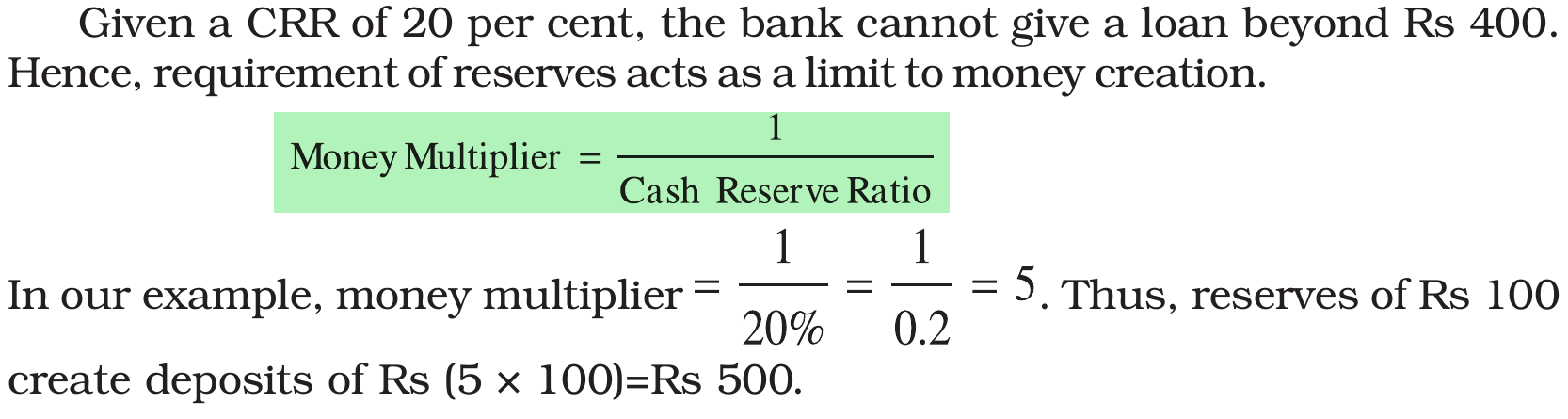
A bank keeps only a part of its deposits as reserves and lends the rest. The money multiplier shows how many times the reserves can support deposits. It equals 1 divided by the CRR.

Money multiplier = 1 ÷ 0.5 = 2

The multiplier depends only on the CRR, so the Rs 100 of reserves does not enter this working.

NCERT (2026-27): Introductory Macroeconomics — Chapter 3: Money and Banking

NCERT extract

Advertisement

Practise more on Macro Economics: Money and Banking

Chapter-wise mocks on the real NTA exam screen, with solutions and your rank. Your first mocks are free.

Start free mocks →

Advertisement

Next questions

  1. Which of the following terms can be used to express flocculation?Chemistry · Physical: Surface Chemistry
  2. K, N and P are partners sharing profits and losses in the ratio of 4:3:2. N retires and the goodwill is valued at ₹72,000. K and P decided…Accountancy Part A · Reconstitution of Partnership Firm: Retirement and Death
  3. Two pipes A and B can fill a tank in 40 minutes and 60 minutes respectively. Both pipes A and B are opened together. After some time pipe A…Applied Maths. Section B2 · Numbers, Quantification and Numerical Applications
  4. Which trophic level consists of organisms that primarily feed on other animals?Biology · Ecosystem
  5. A motor boat can row at the speed of 12 km/h in still water. If the river is flowing at 4 km/h and it takes 12 hours for a round trip, then…Applied Maths. Section B2 · Numbers, Quantification and Numerical Applications
  6. Water is poured at the rate of 9π cm3/s into a vessel in the form of an inverted right circular cone of height 12 cm and base radius 6 cm.…Maths. Section B1 · Applications of Derivatives
  7. अकालपीड़ित शब्द में कौन-सा समास है?Hindi · व्याकरण - ससमास
  8. In which of the following years did Sarojini Naidu preside over the Indian National Congress session?General Aptitude Test · General Knowledge
  9. इनमें से 'मुख' का पर्यायवाची शब्द नहीं है -Hindi · Synonyms
  10. In gel electrophoresis, the separated DNA fragments can be visualised after staining with:Biology · Biotechnology -Principles and Processes