
CUETMOCK
  • Pricing
  • Mentors
Log inStart freeStart free mocks→

First test, then trust

Try a free CUET mock test.

Join 5,00,000+ students who rehearsed exam day on the exact NTA screen before sitting CUET. On the web and on Android.

Start free mocks →Get the Android app
CUETMOCK

India's #1 CUET Mock Test Platform. Original NCERT-based questions on the exact NTA exam screen — trusted by 5,00,000+ students since CUET 2022.

Get it onGoogle PlayScan to download the CUETMOCK app

Mock tests

  • CUET mock test series
  • Commerce mocks
  • Humanities (Arts) mocks
  • Science mocks
  • Languages & GAT mocks
  • Free practice questions
  • Pricing

Resources

  • CUET exam guide
  • CUET syllabus
  • Universities accepting CUET
  • Expert blogs
  • News & notifications
  • Webinars & counselling
  • CUET score calculator
  • How we estimate your rank
  • FAQs

Company

  • About us
  • Our leadership & team
  • Our toppers
  • Mentors
  • For schools
  • Contact us
  • Terms
  • Privacy
  • Refund policy

Talk to us

+91 7696 6630 56info@cuetmock.comWhatsApp us

Our other platforms

  • JEE Mock — For IIT-JEE aspirants
  • NEET Mock — For NEET aspirants

Newsletter

Exam updates, study material and offers — no spam.

© 2026 NYC Ventures Pvt. Ltd.

701-702, Royal Business Park, Zirakpur, Punjab - 140603

  • Terms of use
  • Privacy policy
  • Refund policy
  • Contact us

iCUETMOCK is an independent preparation platform, not affiliated with the National Testing Agency (NTA). Always check exam details on the official NTA website.

  • Home
  • Mock tests
  • CUET guide
  • Pricing
  • Log in
Home/Practice questions/Physics
PhysicsRay Optics

A combination of thin lenses in contact(A) helps to obtain diverging…

A combination of thin lenses in contact

(A) helps to obtain diverging or converging lenses of desired magnification.

(B) has the net power equal to the algebraic sum of their individual powers.

(C) is used in designing lenses for many optical instruments.

(D) enhances sharpness of the image.

Choose the correct answer from the options given below:

Answer & explanation+

Correct answer: option 3

The correct answer is Option (3) → (A), (B), (C) and (D)

For thin lenses in contact the net power is \( P = P_{1} + P_{2} + P_{3} + \dots \), and the net magnification is the product of the individual magnifications.

(A) helps to obtain diverging or converging lenses of desired magnification. — Correct. By combining converging and diverging lenses of suitable powers, a system of the required power, and hence the required magnification, can be obtained.

(B) has the net power equal to the algebraic sum of their individual powers. — Correct. From \( 1/f = 1/f_{1} + 1/f_{2} + \dots \), \( P = P_{1} + P_{2} + \dots \), with converging lenses taken positive and diverging lenses negative.

(C) is used in designing lenses for many optical instruments. — Correct. The lenses of cameras, microscopes and telescopes are combinations of lenses.

(D) enhances sharpness of the image. — Correct. A suitable combination reduces the defects (aberrations) of a single lens, so the image is sharper.

NCERT (2026-27):
Combination of Thin Lenses in Contact – “… The derivation is valid for any number of thin lenses in contact. If several thin lenses of focal length \( f_1, f_2, f_3,\ldots \) are in contact, the effective focal length of their combination is given by

    \( \displaystyle \frac{1}{f} = \frac{1}{f_1} + \frac{1}{f_2} + \frac{1}{f_3} + \ldots \qquad (9.31) \)

In terms of power, Eq. (9.31) can be written as

    \( P = P_1 + P_2 + P_3 + \ldots \qquad (9.32) \)

where \( P \) is the net power of the lens combination. Note that the sum in Eq. (9.32) is an algebraic sum of individual powers, so some of the terms on the right side may be positive (for convex lenses) and some negative (for concave lenses). Combination of lenses helps to obtain diverging or converging lenses of desired magnification. It also enhances sharpness of the image. Since the image formed by the first lens becomes the object for the second, Eq. (9.25) implies that the total magnification \( m \) of the combination is a product of magnification \( (m_1, m_2, m_3,\ldots) \) of individual lenses

    \( m = m_1 m_2 m_3 \ldots \qquad (9.33) \)

Such a system of combination of lenses is commonly used in designing lenses for cameras, microscopes, telescopes and other optical instruments.”
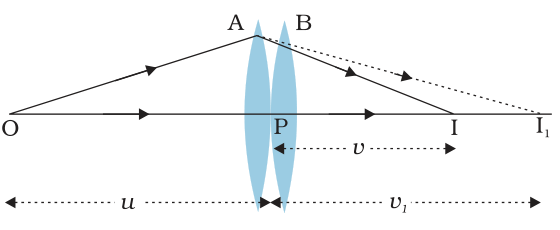
Textbook figure

Advertisement

Practise more on Ray Optics

Chapter-wise mocks on the real NTA exam screen, with solutions and your rank. Your first mocks are free.

Start free mocks →

Advertisement

Next questions

  1. Rearrange the following phrases to complete the beginning of a sentence:Health care is-A. but it includes a multitude of servicesB. not jus…English · Arrange in Meaningful Sequence
  2. An alphanumeric series is given with one term missing. Select the correct alternative from the given ones that will complete the series.D2,…General Aptitude Test · Verbal Reasoning
  3. Which of the following is the decadent phase of the Harappan Civilization?History · Ancient India: Bricks, Beads and Bones
  4. Which of these purposes does not pertain to charts?Accountancy Part C · Graphs and Charts for Business Data
  5. The relative lowering of vapor pressure of a dilute solution can be expressed asChemistry · Physical: Solutions
  6. Choose the most appropriate option which best expresses the meaning of the given idiom:Bury the hatchetEnglish · Grammar: Idioms
  7. The Balance Sheet as on April 1, 2025 of Mohit, Neeraj and Sohan who are partners in a firm sharing profits according to their capitals sho…Accountancy Part A · Reconstitution of Partnership Firm: Retirement and Death
  8. The percentage of the Group-18 gas in the tanks used by scuba divers isChemistry · Physical: Solutions
  9. Match the LIST-I with LIST-II:LIST-IEventLIST-IITimelineA.Mutiny starts in MeerutI.30 MayB.Sepoy mutiny in EtawahII.10 MayC.Rising in Luckn…History · Modern India: Rebels and the Raj
  10. Which of the isomers of the compound “A” has maximum boiling point?Chemistry · Organic: Alcohols, Phenols and Ethers