CUETMOCK
  • Pricing
  • Mentors
Log inStart freeStart free mocks→

First test, then trust

Try a free CUET mock test.

Join 5,00,000+ students who rehearsed exam day on the exact NTA screen before sitting CUET. On the web and on Android.

Start free mocks →Get the Android app
CUETMOCK

India's #1 CUET Mock Test Platform. Original NCERT-based questions on the exact NTA exam screen — trusted by 5,00,000+ students since CUET 2022.

Get it onGoogle PlayScan to download the CUETMOCK app

Mock tests

  • CUET mock test series
  • Commerce mocks
  • Humanities (Arts) mocks
  • Science mocks
  • Languages & GAT mocks
  • Free practice questions
  • Pricing

Resources

  • CUET exam guide
  • CUET syllabus
  • Universities accepting CUET
  • Expert blogs
  • News & notifications
  • Webinars & counselling
  • CUET score calculator
  • How we estimate your rank
  • FAQs

Company

  • About us
  • Our leadership & team
  • Our toppers
  • Mentors
  • For schools
  • Contact us
  • Terms
  • Privacy
  • Refund policy

Talk to us

+91 7696 6630 56info@cuetmock.comWhatsApp us

Our other platforms

  • JEE Mock — For IIT-JEE aspirants
  • NEET Mock — For NEET aspirants

Newsletter

Exam updates, study material and offers — no spam.

© 2026 NYC Ventures Pvt. Ltd.

701-702, Royal Business Park, Zirakpur, Punjab - 140603

  • Terms of use
  • Privacy policy
  • Refund policy
  • Contact us

iCUETMOCK is an independent preparation platform, not affiliated with the National Testing Agency (NTA). Always check exam details on the official NTA website.

  • Home
  • Mock tests
  • CUET guide
  • Pricing
  • Log in
Home/Practice questions/History
HistoryAncient India: Bricks, Beads and Bones

Which of the following is the decadent phase of the Harappan Civiliza…

Which of the following is the decadent phase of the Harappan Civilization?

Answer & explanation+

Correct answer: option 1

The correct answer is Option (1) → 1900 BCE - 1300 BCE

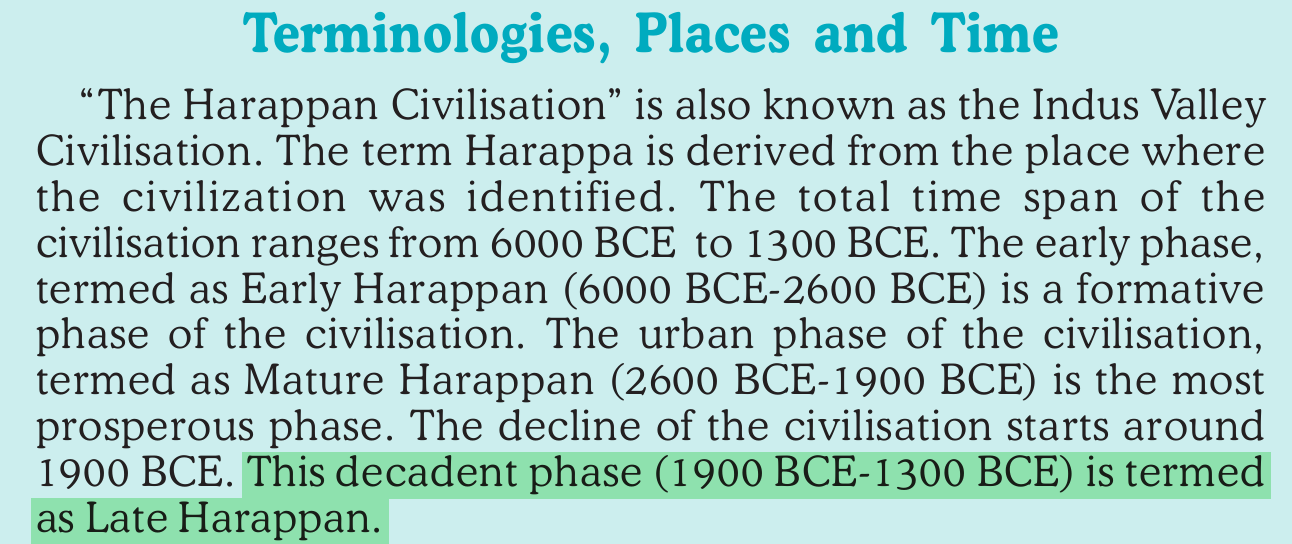
The Harappan civilisation lasted from about 6000 BCE to 1300 BCE, and historians divide this long span into three phases. The Early Harappan phase (6000-2600 BCE) was the formative phase. The Mature Harappan phase (2600-1900 BCE) was the urban and most prosperous phase, the age of the great cities. The decline began around 1900 BCE, and this decadent phase (1900-1300 BCE) is called the Late Harappan phase.

Option (2), 2600-1900 BCE, is the Mature Harappan phase, the very opposite of decline.


NCERT: Themes in Indian History Part I — Chapter 1: Bricks, Beads and Bones (2025-26)

NCERT extract

Advertisement

Practise more on Ancient India: Bricks, Beads and Bones

Chapter-wise mocks on the real NTA exam screen, with solutions and your rank. Your first mocks are free.

Start free mocks →

Advertisement

Next questions

  1. Which of these purposes does not pertain to charts?Accountancy Part C · Graphs and Charts for Business Data
  2. The relative lowering of vapor pressure of a dilute solution can be expressed asChemistry · Physical: Solutions
  3. Choose the most appropriate option which best expresses the meaning of the given idiom:Bury the hatchetEnglish · Grammar: Idioms
  4. The Balance Sheet as on April 1, 2025 of Mohit, Neeraj and Sohan who are partners in a firm sharing profits according to their capitals sho…Accountancy Part A · Reconstitution of Partnership Firm: Retirement and Death
  5. The percentage of the Group-18 gas in the tanks used by scuba divers isChemistry · Physical: Solutions
  6. Match the LIST-I with LIST-II:LIST-IEventLIST-IITimelineA.Mutiny starts in MeerutI.30 MayB.Sepoy mutiny in EtawahII.10 MayC.Rising in Luckn…History · Modern India: Rebels and the Raj
  7. Which of the isomers of the compound “A” has maximum boiling point?Chemistry · Organic: Alcohols, Phenols and Ethers
  8. India is collaborating with which one of the following neighbouring countries for the Kaladan Multimodal Transit Transport Project?General Aptitude Test · Current Affairs
  9. Choose the correct option after joining the given sentences.I wanted to go for a walk. It started raining.English · Grammar: Conjunction
  10. A screen is placed 80 cm from an object. The image of the object on the screen is formed by a convex lens placed between them at two differ…Physics · Ray Optics