The relative lowering of vapor pressure of a dilute solution can be expressed as
Answer & explanation
Correct answer: option 1
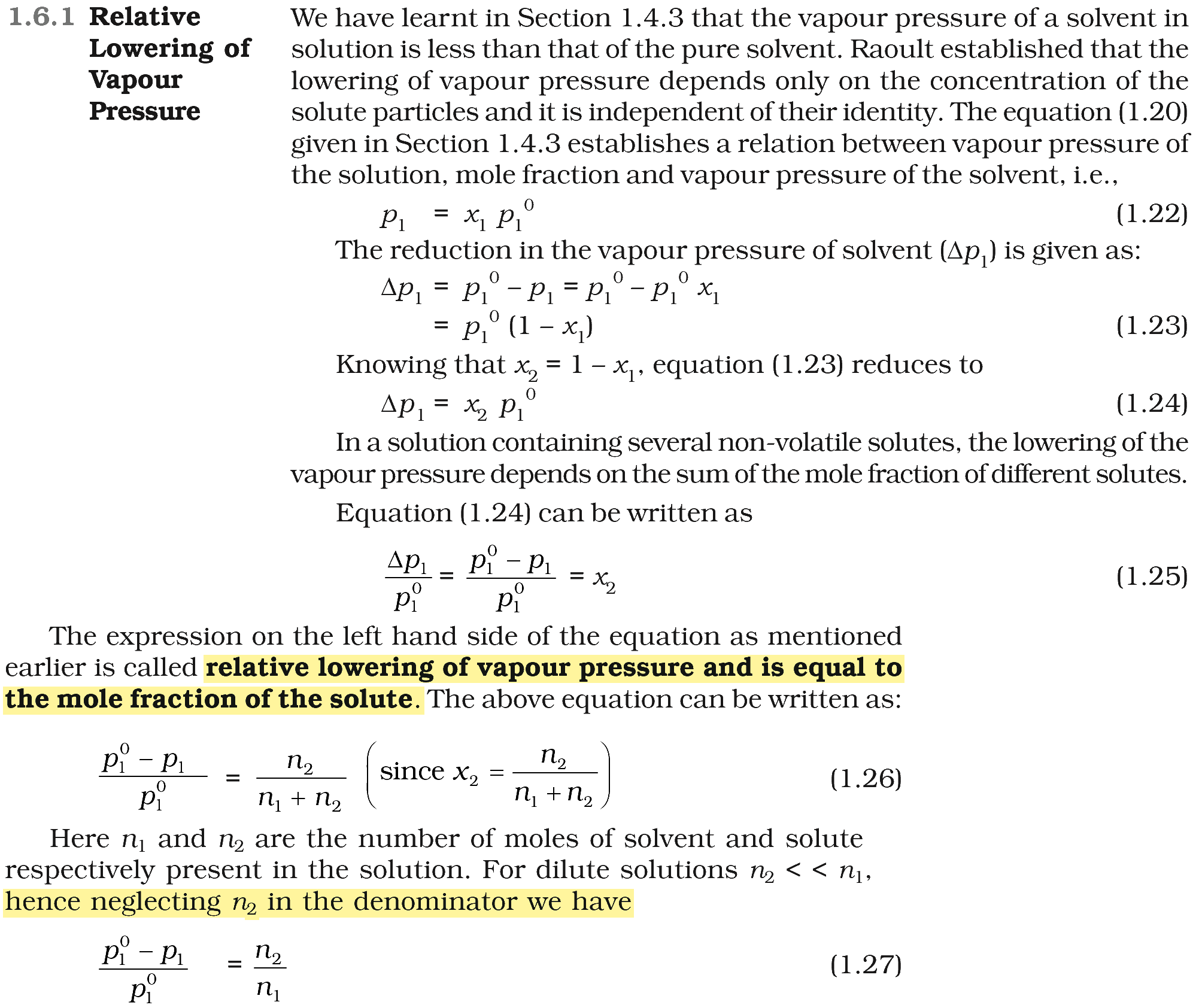
The correct answer is Option (1) → \( \displaystyle \frac{p_1^0-p_1}{p_1^0}=\frac{n_2}{n_1} \)
When a non-volatile solute is dissolved in a solvent, the vapour pressure of the solvent falls from p10 to p1. By Raoult’s law the relative lowering of vapour pressure equals the mole fraction of the solute, x2 = n2/(n1 + n2). In a dilute solution n2 is negligible beside n1, so the relative lowering becomes the ratio of moles of solute to moles of solvent.
Why the other options are incorrect
Option (2) \( \frac{p_1^0-p_1}{p_1^0}=\frac{n_1}{n_2} \) — Incorrect. The ratio is inverted; n1/n2 would be a very large number for a dilute solution.
Option (3) \( \frac{p_1^0-p_1}{p_1^0}=\frac{n_2RT}{V} \) — Incorrect. n2RT/V is the osmotic pressure (π = CRT), a pressure, not a dimensionless ratio.
Option (4) \( \frac{p_1^0-p_1}{p_1^0}=\frac{n_2V}{RT} \) — Incorrect. n2V/RT has the units of mol per unit pressure, so it is not a dimensionless ratio; it is the osmotic-pressure term turned upside down.
NCERT (2026-27 edition):
Relative Lowering of Vapour Pressure