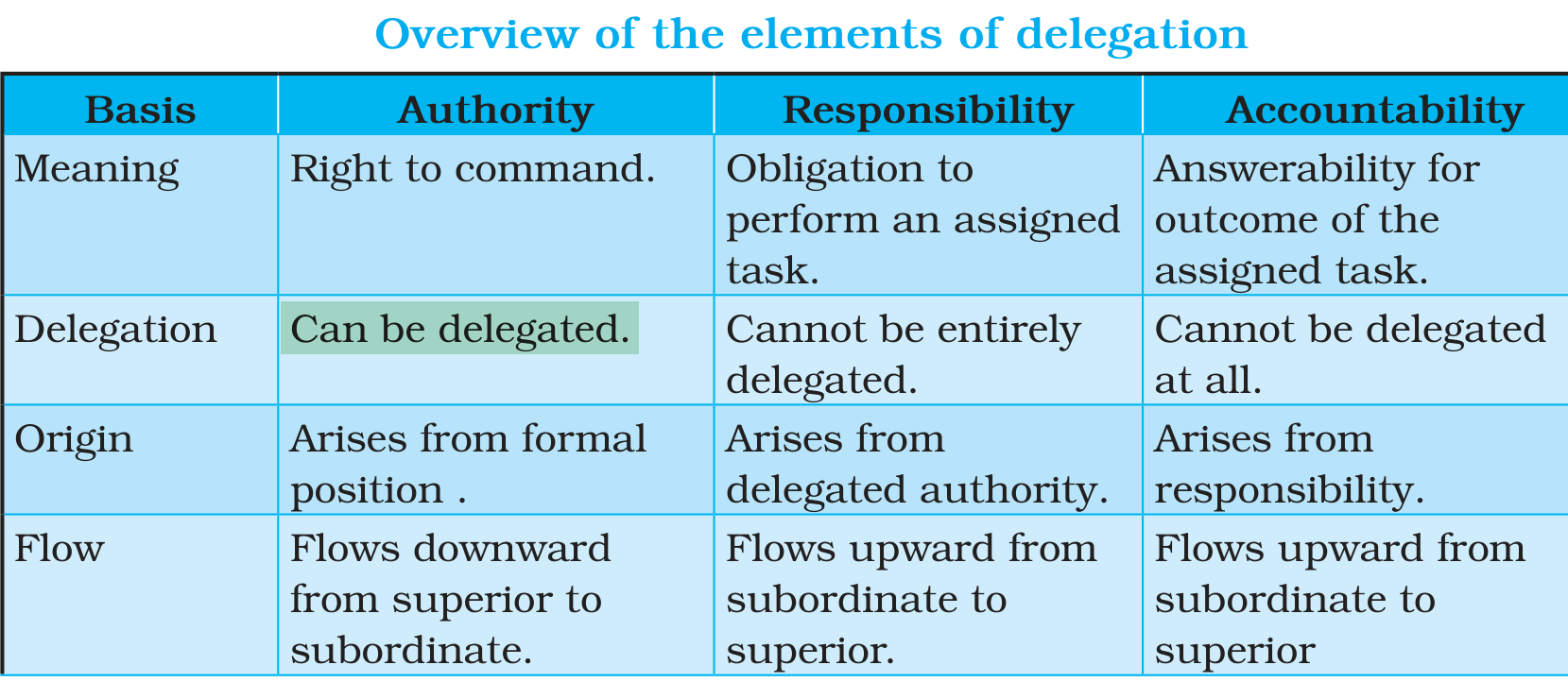
Out of the following statement, which is not false?
Answer & explanation
Correct answer: option 4
The correct answer is Option (4) → Authority can be delegated
Option (1) Responsibility can be entirely delegated — False (Incorrect). This is false. Responsibility cannot be entirely delegated.
Option (2) Accountability can be delegated — False (Incorrect). This is false. Accountability cannot be delegated and flows upwards.
Option (3) Delegation means abdication — False (Incorrect). This is false. Delegation does not mean abdication. The manager is still accountable.
Option (4) Authority can be delegated — Not false (Correct). This is true. Authority is delegated, responsibility is assumed and accountability is imposed.
NCERT (2026-27 Edition): “(i) Authority: Authority refers to the right of an individual to command his subordinates and to take action within the scope of his position. …” “Delegation … Delegation refers to the downward transfer of authority from a superior to a subordinate. It is a pre-requisite to the efficient functioning of an organisation because it enables a manager to use his time on high priority activities. …” “Delegation helps a manager to extend his area of operations as without it, his activities would be restricted to only what he himself can do. However, delegation does not mean abdication. The manager shall still be accountable for the performance of the assigned tasks. …” “(iii) Accountability: Delegation of authority, undoubtedly empowers an employee to act for his superior but the superior would still be accountable for the outcome: Accountability implies being answerable for the final outcome. Once authority has been delegated and responsibility accepted, one cannot deny accountability. It cannot be delegated and flows upwards, i.e., a subordinate will be accountable to a superior for satisfactory performance of work. …”
|