CUETMOCK
  • Pricing
  • Mentors
Log inStart freeStart free mocks→

First test, then trust

Try a free CUET mock test.

Join 5,00,000+ students who rehearsed exam day on the exact NTA screen before sitting CUET. On the web and on Android.

Start free mocks →Get the Android app
CUETMOCK

India's #1 CUET Mock Test Platform. Original NCERT-based questions on the exact NTA exam screen — trusted by 5,00,000+ students since CUET 2022.

Get it onGoogle PlayScan to download the CUETMOCK app

Mock tests

  • CUET mock test series
  • Browse all papers
  • Commerce mocks
  • Humanities (Arts) mocks
  • Science mocks
  • Languages & GAT mocks
  • Free practice questions
  • Pricing

Resources

  • CUET exam guide
  • CUET syllabus
  • Universities accepting CUET
  • Expert blogs
  • News & notifications
  • Webinars & counselling
  • CUET score calculator
  • How we estimate your rank
  • FAQs

Company

  • About us
  • Our leadership & team
  • Our toppers
  • Mentors
  • For schools
  • Contact us
  • Terms
  • Privacy
  • Refund policy

Talk to us

+91 7696 6630 56info@cuetmock.comWhatsApp us

Our other platforms

  • JEE Mock — For IIT-JEE aspirants
  • NEET Mock — For NEET aspirants

Newsletter

Exam updates, study material and offers — no spam.

© 2026 NYC Ventures Pvt. Ltd.

701-702, Royal Business Park, Zirakpur, Punjab - 140603

  • Terms of use
  • Privacy policy
  • Refund policy
  • Contact us

iCUETMOCK is an independent preparation platform, not affiliated with the National Testing Agency (NTA). Always check exam details on the official NTA website.

  • Home
  • Mock tests
  • CUET guide
  • Pricing
  • Log in
Home/Practice questions/Economics
EconomicsMacro Economics: Money and Banking

Which of the following is not a part of money supply ?

Which of the following is not a part of money supply ?

Answer & explanation+

Correct answer: option 4

The correct answer is Option (4) → Recurring deposits

Note: The given answer is as per the official NTA Answer Key. However, there seems to be a mistake in the question. Recurring deposits are time deposits, and time deposits are part of money supply (M3). Reserve money fits the question better. Only one part of it, the currency held by the public, is also in money supply, as explained below.

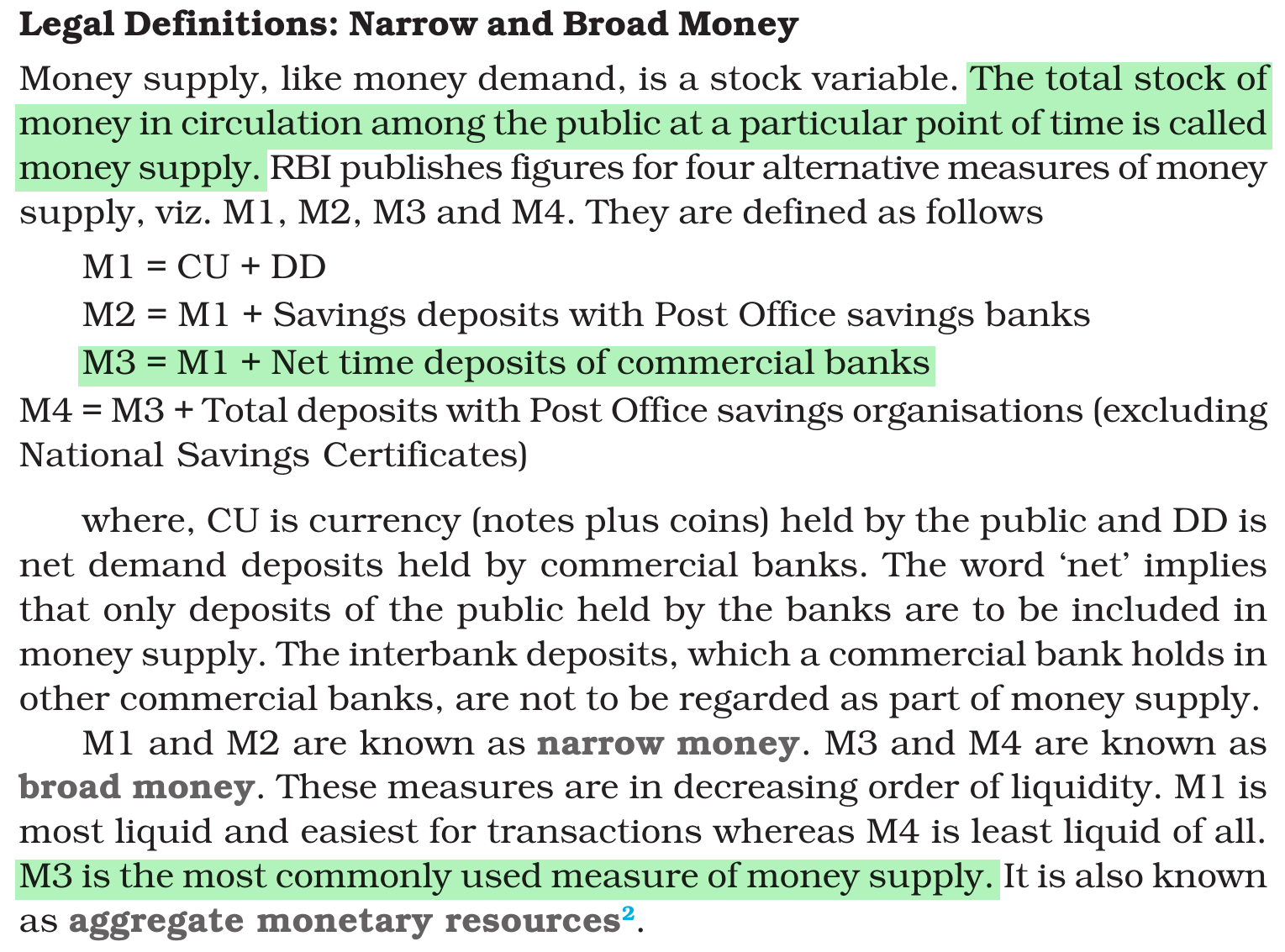
Money supply is the total stock of money held by the public at a point of time. The narrow measure M1 is currency held by the public plus net demand deposits with commercial banks. The broad measure M3, the most commonly used one, adds net time deposits of commercial banks to M1.

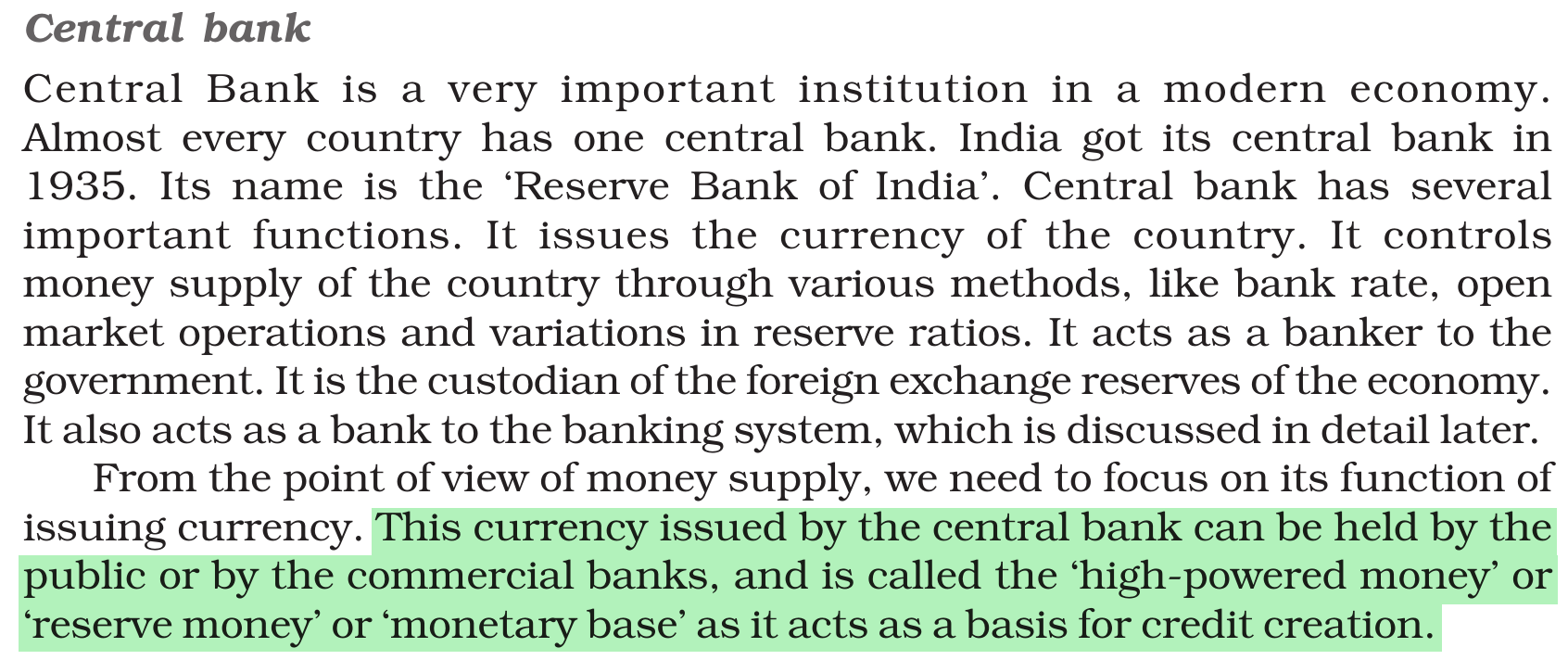
  • Option (1) Reserve money — Not a part of money supply. Should be correct. Reserve money, also called high-powered money, is the currency issued by the RBI, held either by the public or by commercial banks. It is the base on which banks create money. The currency held by the public is in money supply too. But the cash that banks keep as reserves is not counted in money supply, which takes only what the public holds.

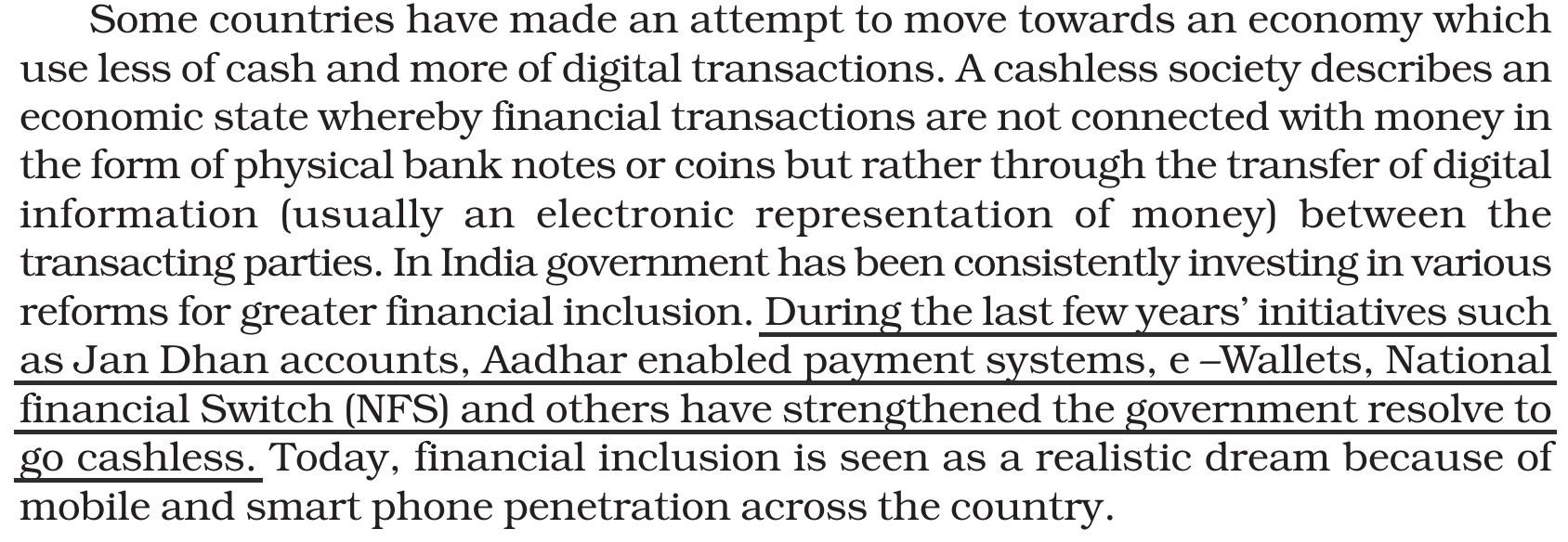
  • Option (2) E-wallets — Part of money supply (Incorrect). An e-wallet holds money that its owner can spend at once, like cash. It is a way of making cashless payments with money the public already holds, not a separate kind of money.

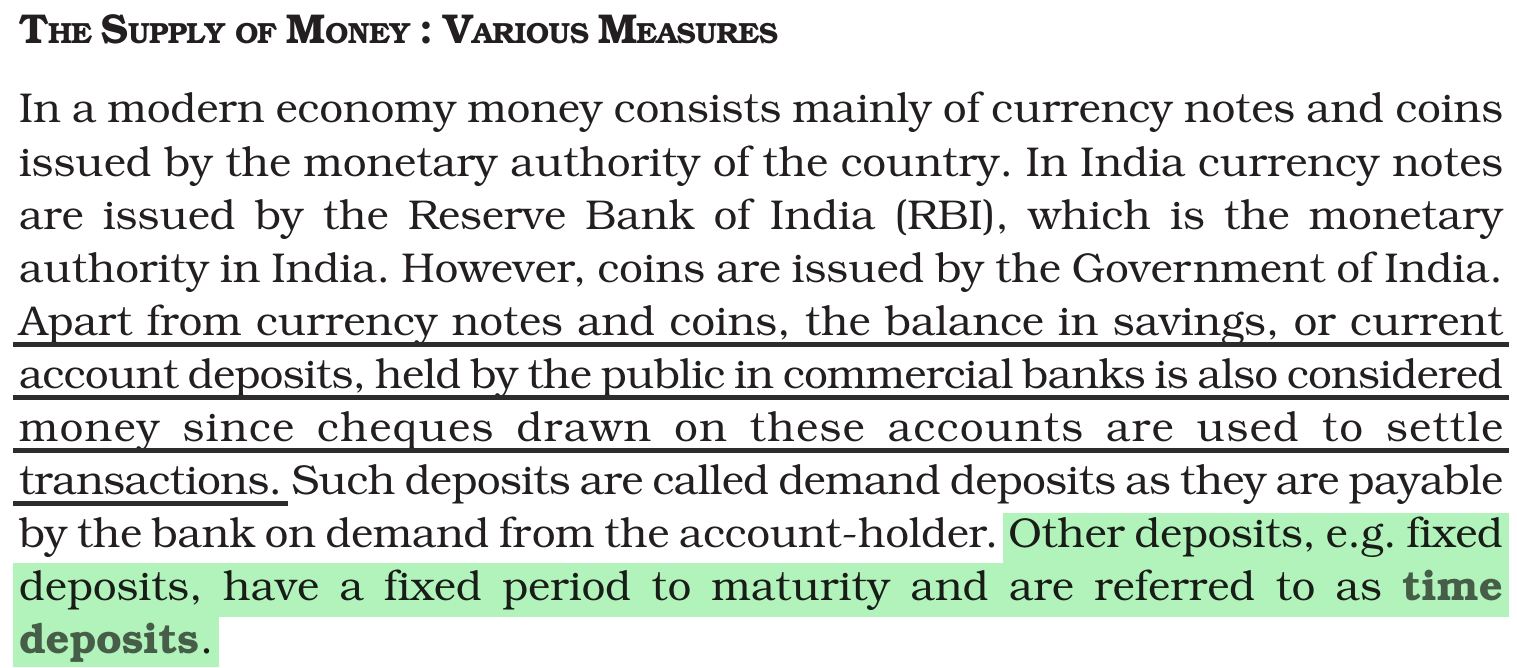
  • Option (3) Saving deposits — Part of money supply (Incorrect). Money in a savings account can be drawn on demand and used through cheques. It is a demand deposit, so it is part of M1.

  • Option (4) Recurring deposits — Part of money supply. The answer given by NTA, but it seems to be incorrect. A recurring deposit runs for a fixed period to maturity, like a fixed deposit, so it is a time deposit. Net time deposits of banks are part of M3. They are outside only the narrow measure M1.

Advice for the exam: In the real exam, mark the answer that is correct as per economic principles and the NCERT book. If NTA’s provisional answer key marks a different option, challenge it during the answer-key challenge window, giving proper reasoning. NTA does revise its key when a challenge is well justified, so a sound challenge can raise your marks.

NCERT (2026-27): Introductory Macroeconomics — Chapter 3: Money and Banking

NCERT extract

NCERT extract

NCERT extract

NCERT extract

Advertisement

Practise more on Macro Economics: Money and Banking

Chapter-wise mocks on the real NTA exam screen, with solutions and your rank. Your first mocks are free.

Start free mocks →

Advertisement

Next questions

  1. If A = […] , then the determinant of the matrix A^5 - 3A^4 isApplied Maths. Section B2 · Algebra
  2. In a triangle ABC, DE is parallel to BC; AD = a, DB = a + 4, AE = 2a + 3, EC = 7a. What is the value of 'a’ if a > 0 ?General Aptitude Test · Quantitative Reasoning
  3. Arrange the following cities present on Trans-Canadian Railways Route from East to West direction:A. SydneyB. OttawaC. MontrealD. QuebecE.…Geography · Fundamentals of Human Geography: Transport and Communication
  4. Gause’s ‘Competitive Exclusion Principle’ states that -Biology · Organisms and Populations
  5. Fill in the blank with the most appropriate option:He _______me for the last few months that he is leaving India very soon.English · Grammar: Tenses
  6. The workers of a factory remain idle because of lack of knowledge about hi-tech machines. Frequent visits by engineer is made, which causes…Business Studies · Staffing
  7. Identify the compound (C) in the reaction sequence given in the passage.Chemistry · Organic: Aldehydes, Ketones and Carboxylic Acids
  8. A historian sorts the terms Kabir used for the Ultimate Reality. Match List-I (Term) with List-II (Meaning and source).List-IList-II(A) ala…History · Medieval India: Bhakti Sufi Traditions
  9. The saving function of an economy is S = −30 + 0.2Y (Rs crore) and autonomous investment is Rs 50 crore. What is the consumption expenditur…Economics · Macro Economics: Determination of Income and Employment
  10. Indian painting went through several changes in the nineteenth and early twentieth centuries. Arrange the following developments in the cor…Fine Arts · The Bengal School and Cultural Nationalism