
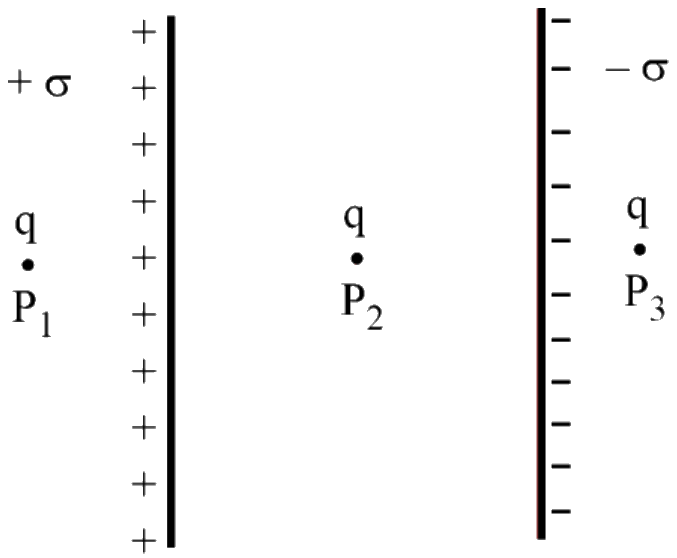
Two large plane parallel sheets shown in the figure have equal but opposite surface charge densities \( +\sigma \) and \( -\sigma \). A point charge q placed at points \( P_1 \), \( P_2 \) and \( P_3 \) experiences forces \( F_1 \), \( F_2 \) and \( F_3 \) respectively. Then
Choose the correct answer from the options given below.
Answer & explanation
Correct answer: option 2
The correct answer is Option (2) → \( \vec{F}_1 = 0,\ \vec{F}_2 \ne 0,\ \vec{F}_3 = 0 \)
A large plane sheet of charge produces a uniform field \( \sigma/2\varepsilon_0 \) on each side, directed away from a positive sheet and towards a negative sheet. The net field is the vector sum of the fields of the two sheets.
From the figure, \( P_1 \) is outside the sheets on the \( +\sigma \) side, \( P_2 \) is between the sheets and \( P_3 \) is outside on the \( -\sigma \) side.
Outside the sheets (at \( P_1 \) and \( P_3 \)), the field of the positive sheet points one way and the field of the negative sheet points the other way, with equal magnitude, so they cancel.
\( \displaystyle E_{1} = E_{3} = \frac{\sigma}{2\varepsilon_0} - \frac{\sigma}{2\varepsilon_0} = 0 \)
Between the sheets (at \( P_2 \)), both fields point from the positive sheet towards the negative sheet, so they add.
\( \displaystyle E_{2} = \frac{\sigma}{2\varepsilon_0} + \frac{\sigma}{2\varepsilon_0} = \frac{\sigma}{\varepsilon_0} \)
The force on the charge is \( \vec{F} = q\vec{E} \), so \( \vec{F}_1 = 0 \), \( \vec{F}_2 \ne 0 \) and \( \vec{F}_3 = 0 \).
NCERT (2026-27):
The Parallel Plate Capacitor – “… Plate 1 has surface charge density σ = Q/A and plate 2 has a surface charge density –σ. Using Eq. (1.33), the electric field in different regions is:
Outer region I (region above the plate 1),
\( \displaystyle E = \frac{\sigma}{2\varepsilon_0} - \frac{\sigma}{2\varepsilon_0} = 0 \qquad (2.39) \)
Outer region II (region below the plate 2),
\( \displaystyle E = \frac{\sigma}{2\varepsilon_0} - \frac{\sigma}{2\varepsilon_0} = 0 \qquad (2.40) \)
In the inner region between the plates 1 and 2, the electric fields due to the two charged plates add up, giving
\( \displaystyle E = \frac{\sigma}{2\varepsilon_0} + \frac{\sigma}{2\varepsilon_0} = \frac{\sigma}{\varepsilon_0} = \frac{Q}{\varepsilon_0 A} \qquad (2.41) \)”