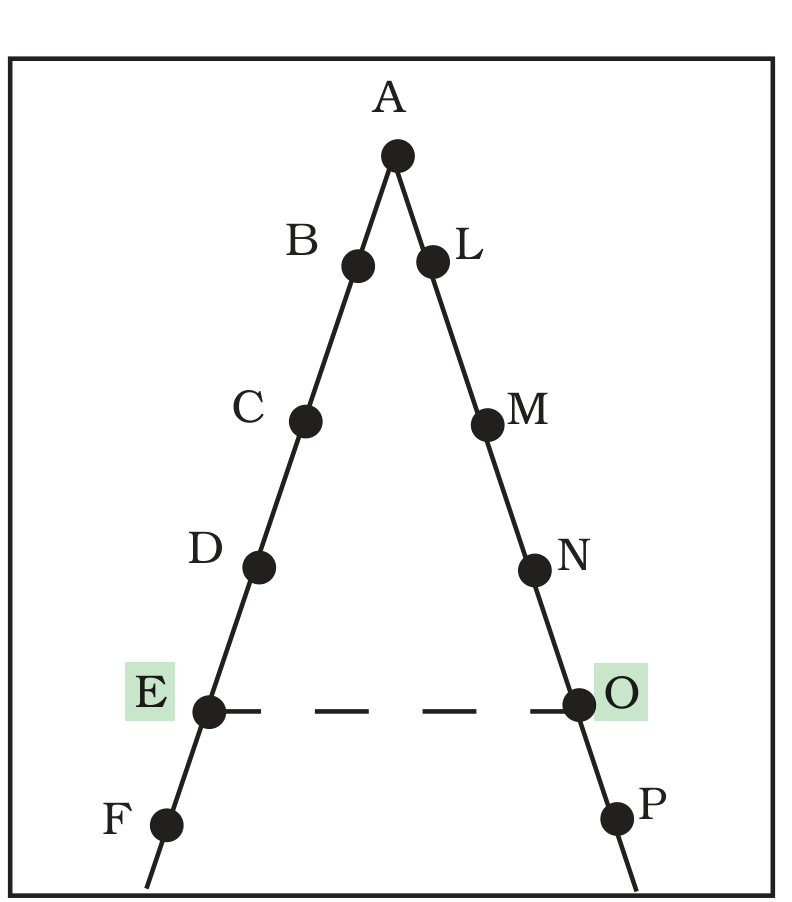
The "gangplank" in the Scalar Chain principle emphasizes:
Answer & explanation
Correct answer: option 4
The correct answer is Option (4) → Direct communication for urgent matters
Option (1) Strict adherence to the chain of authority — Incorrect. This is the scalar chain itself. In normal formal communication the chain must be followed. The gangplank is the exception to it.
Option (2) Overlapping roles and responsibilities — Incorrect. The gangplank does not mix up anyone’s duties. Each person keeps his own role. Only the route of the message becomes shorter.
Option (3) Centralization of decision-making — Incorrect. Centralisation means keeping the decision-making power at the top. It is a different principle of Fayol.
Option (4) Direct communication for urgent matters — Correct. The scalar chain is the formal line of authority from the highest to the lowest rank. If E has to contact O at the same level, the message must go up to A and come down again. In an emergency, E can contact O directly through a ‘gang plank’. This shorter route stops communication from being delayed.
NCERT (2026-27 Edition): “Scalar Chain: An organisation consists of superiors and subordinates. The formal lines of authority from highest to lowest ranks are known as scalar chain.” “…According to Fayol, this chain should not be violated in the normal course of formal communication. However, if there is an emergency then ‘E’ can directly contact ‘O’ through ‘Gang Plank’ as shown in the diagram. This is a shorter route and has been provided so that communication is not delayed. …”
|