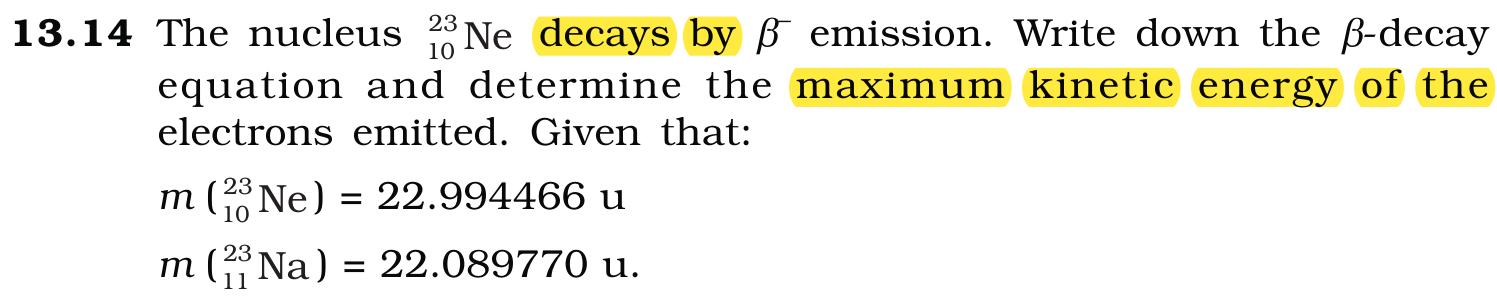
Suppose the nucleus ‘X’ (mass \(= 22.994466\) u) decays with the emission of a beta particle, producing nucleus ‘Y’ (mass \(=\) \(22.989770\) u). The kinetic energy of the beta particle will be:
(Given: \(1\) u of mass is equivalent to \(931\) MeV of energy)
Answer & explanation
Correct answer: option 4
The correct answer is Option (4) → \(4.372\) MeV
In \( \beta^{-} \) decay, \( X \to Y + e^{-} + \bar{\nu} \). The energy released (Q-value) comes from the mass defect. With atomic masses, the electron masses cancel, so
\( \displaystyle Q = [M(X) - M(Y)]c^{2} \)
\( \displaystyle \Delta m = 22.994466\,\mathrm{u} - 22.989770\,\mathrm{u} = 0.004696\,\mathrm{u} \)
\( \displaystyle Q = 0.004696\,\mathrm{u} \times 931\,\mathrm{MeV\,u^{-1}} \)
\( \displaystyle Q \approx 4.372\,\mathrm{MeV} \)
The heavy daughter nucleus takes almost no recoil energy, so the Q-value is shared between the \( \beta \) particle and the antineutrino. The \( \beta \) particle has its maximum kinetic energy, 4.372 MeV, when the antineutrino carries away negligible energy; this is the kinetic energy asked for.
Note: It seems that there is a mistake in the original NTA paper, which calls the given values the masses of the nuclei ‘X’ and ‘Y’, when they are atomic masses (they are the atomic masses of \( {}^{23}_{10}\mathrm{Ne} \) and \( {}^{23}_{11}\mathrm{Na} \)). With atomic masses the electron masses cancel and the answer is 4.372 MeV. With true nuclear masses the mass of the emitted electron (0.000549 u) would also have to be subtracted, giving about 3.86 MeV, which is not among the options.
Note: This question is from the pre-rationalised NCERT book (2022-23). The topic was removed from the latest NCERT book (2026-27), and it also appears to be out of the CUET 2026 syllabus.
NCERT (Pre-rationalised edition, 2022-23):
Exercises – …