An organic compound A, molecular formula C6H6O, gives a violet colour with neutral FeCl3 solution. A on treatment with CO2 and NaOH at 400 K under pressure gives B, which on acidification gives a compound C. Compound C reacts with acetyl chloride to give D, which is a popular painkiller.
In the reaction sequence given in the passage, what is the compound (A)?
Answer & explanation
Correct answer: option 3
The correct answer is Option (3) → Phenol
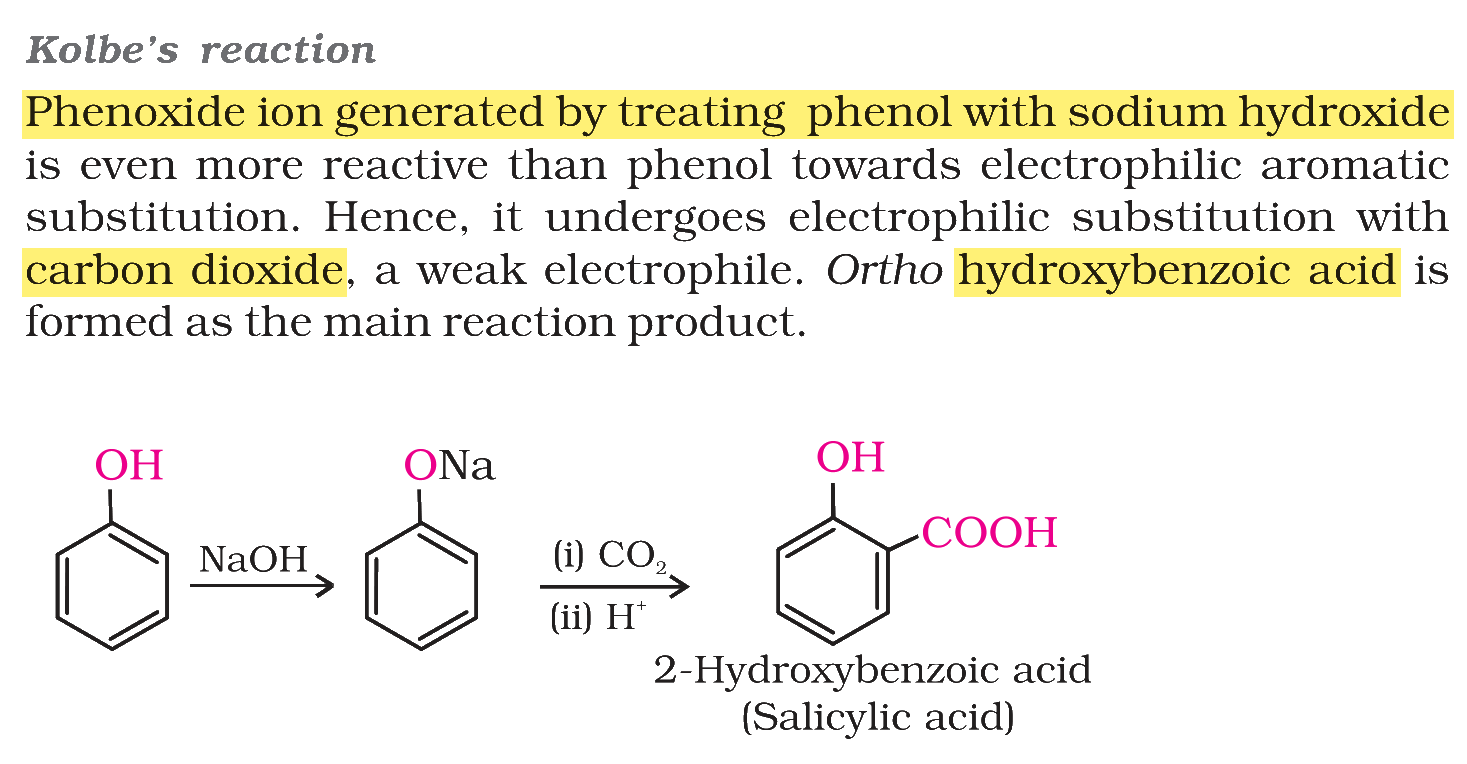
The reaction of a phenol with \( \ce{CO2} \) and \( \ce{NaOH} \) is Kolbe’s reaction. \( \ce{NaOH} \) turns phenol into the phenoxide ion, which is reactive enough to be attacked by the weak electrophile \( \ce{CO2} \) at the ortho position.
The formula \( \ce{C6H6O} \) is \( \ce{C6H5OH} \), so (A) is phenol. Its reactions in the passage:
\( \displaystyle \ce{C6H5OH + NaOH -> C6H5ONa + H2O} \)
\( \displaystyle \ce{C6H5ONa + CO2} \xrightarrow[\text{pressure}]{\text{410 K}} \ce{HOC6H4COONa} \)
The product (B) is sodium salicylate, with the –COONa group ortho to –OH. Acid frees the carboxylic acid (C), salicylic acid (2-hydroxybenzoic acid):
\( \displaystyle \ce{HOC6H4COONa + HCl -> HOC6H4COOH + NaCl} \)
Acetylation of the –OH group of salicylic acid by acetyl chloride gives (D), aspirin (acetylsalicylic acid), the painkiller:
\( \displaystyle \ce{HOC6H4COOH + CH3COCl} \xrightarrow{\text{pyridine}} \ce{CH3COOC6H4COOH + HCl} \)
Why the other options are incorrect
Option (1) Toluene — Incorrect. Toluene, \( \ce{C6H5CH3} \), is \( \ce{C7H8} \): it has no oxygen and no –OH group, so it forms no phenoxide ion with \( \ce{NaOH} \).
Option (2) Benzene — Incorrect. Benzene is \( \ce{C6H6} \), with no oxygen atom. It forms no phenoxide ion with \( \ce{NaOH} \), and \( \ce{CO2} \) is only a weak electrophile.
NCERT (2026-27 edition):
Kolbe’s reaction