
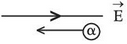
In the figure, an α-particle moves a distance \( l \) in a uniform electric field \( \vec{E} \) as shown. Does the Electric Field do a positive or a negative work on the α-particle? Does the electric potential energy of the α-particle increase or decrease ?
Answer & explanation
Correct answer: option 1
The correct answer is Option (1) → Negative, increases
An α-particle carries a positive charge \( q = +2e \), so the electric force on it, \( \vec{F} = q\vec{E} \), is along the field. The figure shows the particle moving opposite to the field.
\( \displaystyle W = F\,l\cos 180^\circ = -qEl \)
So the field does negative work.
The change in electric potential energy is the negative of the work done by the field:
\( \displaystyle \Delta U = -W = +qEl \gt 0 \)
So the potential energy increases. (Equivalently, the particle moves against the field, towards higher potential, and a positive charge at higher potential has more potential energy.)
NCERT (2026-27):
Introduction – “… At every point in electric field, a particle with charge q possesses a certain electrostatic potential energy, this work done increases its potential energy by an amount equal to potential energy difference between points R and P. … (Note here that this displacement is in an opposite sense to the electric force and hence work done by electric field is negative, i.e., –WRP.)”