
Read the paragraph given below and answer the question.
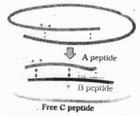
Insulin used for diabetes was earlier extracted from slaughtered cattle and pigs. Insulin from an animal source, though caused some patients to develop allergy or other type of reactions. Insulin consists of two short polypeptide chains: chain A and chain B, that are linked bridges. In mammals, including human, insulin is synthesised as a pro-hormone.
Insulin is synthesised as _____________in mammals.
Answer & explanation
Correct answer: option 1
The correct answer is Option (1) → Pro-hormone
Insulin is composed of two short polypeptide chains, namely chain A and chain B, which are connected by disulfide bridges.
In mammals, including humans, insulin is initially produced as a prohormone, similar to a proenzyme that requires processing to become a fully mature and functional hormone. This prohormone contains an additional segment called the C-peptide. However, during the maturation process into insulin, the C-peptide is removed, and it is not present in the mature insulin.
In 1983, the American company Eli Lilly prepared two DNA sequences corresponding to the A and B chains of human insulin and introduced them into plasmids of Escherichia coli (E. coli) bacteria to produce insulin chains. The A and B chains were generated separately, extracted, and then combined by creating disulfide bonds to form human insulin. This process allowed for the production of synthetic human insulin through rDNA technology, providing a safer and more reliable source of insulin for diabetes management.