
A wire carries a current of \( 5 \) A and consists of a circular arc of radius \( \pi \) cm and central angle \( \displaystyle\frac{\pi}{2} \) rad, and the two straight sections of the wire which intersect at the center of the arc. The magnetic field produced at the center of the arc is
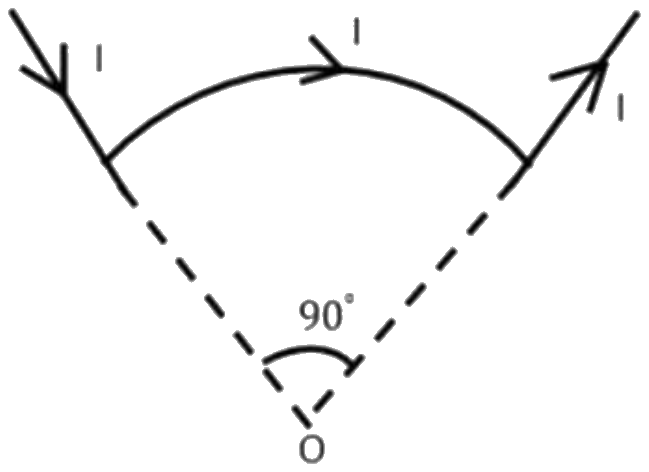
Answer & explanation
Correct answer: option 2
The correct answer is Option (2) → \( 2.5\times10^{-5} \) T (into the plane of paper)
Use the Biot-Savart law for each part of the wire.
The two straight sections point towards the centre O, so at every element \( d\vec{l} \) is along the line to O and \( d\vec{l}\times\vec{r} = 0 \): they give no field at O.
The arc of angle \( \theta \) gives the fraction \( \theta/2\pi \) of the field of a full circle:
\( \displaystyle B = \frac{\theta}{2\pi}\times\frac{\mu_0I}{2r} = \frac{\mu_0I\theta}{4\pi r} \)
\( I = 5\,\mathrm{A} \)
\( r = \pi\,\mathrm{cm} = \pi\times10^{-2}\,\mathrm{m} \)
\( \theta = \pi/2 \)
\( \displaystyle B = \frac{(10^{-7})(5)(\pi/2)}{\pi\times10^{-2}}\,\mathrm{T} = \frac{5\times10^{-7}}{2\times10^{-2}}\,\mathrm{T} = 2.5\times10^{-5}\,\mathrm{T} \)
Direction: the current in the arc goes from left to right over the top of O, which is clockwise as seen on the page. By the right-hand rule, a clockwise current gives a field into the plane of the paper at the centre.