Under which of the following conditions would toluene \(C_6H_5–CH_3\), be converted into bromomethyl benzene, \(C_6H_5–CH_2Br\)?
Answer & explanation
Correct answer: option 3
The correct answer is Option (3) → Reaction with \(Br_2\) in sunlight
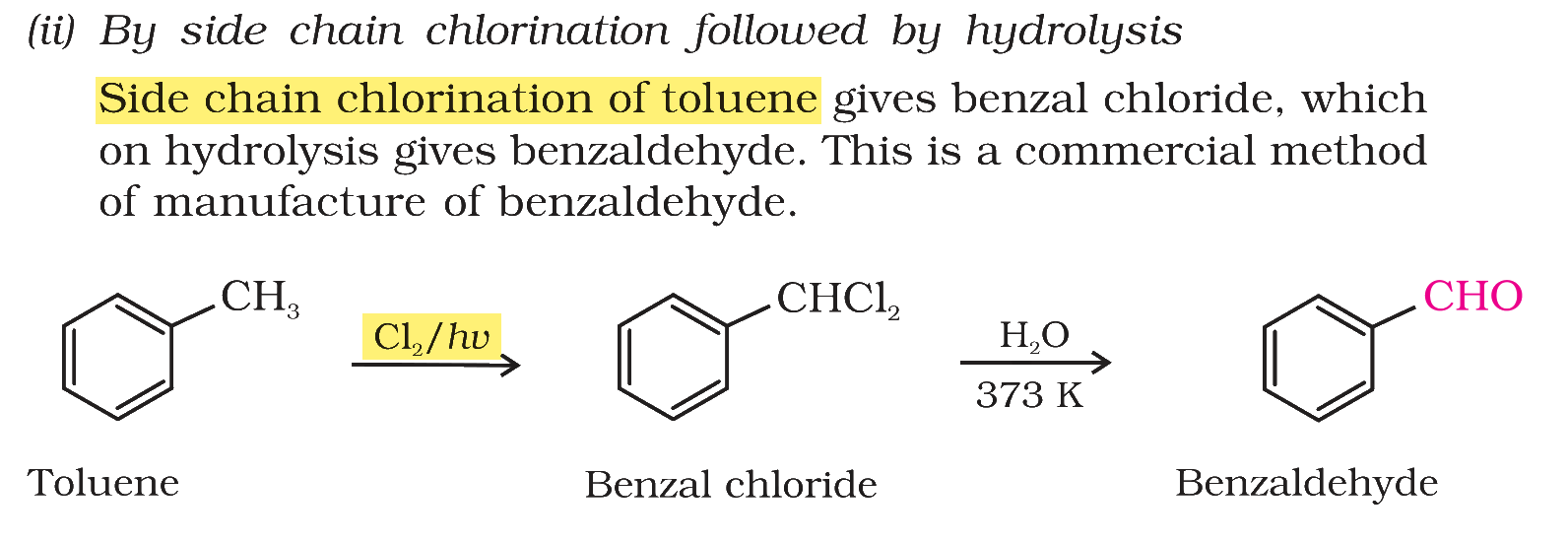
The side chain of toluene reacts by free radical substitution, which needs light; the ring reacts by electrophilic substitution, which needs a Lewis acid. In sunlight, \( \ce{Br2} \) gives bromine atoms, which replace a hydrogen of the \( \ce{-CH3} \) group:
\( \displaystyle \ce{C6H5CH3 + Br2} \xrightarrow{\text{sunlight}} \ce{C6H5CH2Br + HBr} \)
The product is benzyl bromide. The same side-chain reaction takes place with chlorine.
Why the other options are incorrect
Option (1) Reaction with \(Br_2\) in dark — Incorrect. In the dark and without a catalyst, neither bromine atoms nor \( \ce{Br^+} \) form, so no substitution takes place.
Option (2) Reaction with \(Br_2/FeBr_3\) — Incorrect. \( \ce{FeBr3} \) gives \( \ce{Br^+} \), so the ring is brominated at the ortho and para positions:
\( \displaystyle \ce{C6H5CH3 + Br2} \xrightarrow{\ce{FeBr3}} \ce{BrC6H4CH3 + HBr} \)
Option (4) Reaction with \(HBr\) — Incorrect. \( \ce{HBr} \) cannot replace a hydrogen of a C–H bond; it replaces the \( \ce{-OH} \) of alcohols, for example \( \ce{C6H5CH2OH + HBr -> C6H5CH2Br + H2O} \).
NCERT (2026-27 edition):
Preparation of Aldehydes