
Coordination compounds are formulated and named according to the system set up by the Inorganic Nomenclature Committee of the International Union of Pure and Applied Chemistry (IUPAC). It is called the IUPAC System of Nomenclature.
The following rules are applied while writing the formulas:
(i) The formula of the cation whether simple or complex is written first followed by that of the anion.
(ii) The coordination entity is written in square brackets.
(iii) The sequence of symbols within the coordination entity is: first the symbol of the central metal atom followed by ligands in alphabetical order. According to the latest IUPAC recommendations, the placement of a ligand in the list does not depend on its charge. The ligands in the coordination entity are arranged as:
(a) The different ligands are arranged alphabetically according to the first symbol of their formulae. For example, H2O, NH3, NO3–, SO42– and OH–, etc. are cited at H, N, N, S, and O. The ligands containing carbon and hydrogen are cited only under C.
In Werner’s green complex, CoCl3.4NH3, cobalt has a coordination number of six and all four ammonia molecules are bound to cobalt. The compound is written as a complex salt by the rules given above. What mass of AgCl is precipitated when 0.050 mol of this compound is treated with an excess of silver nitrate solution in cold? (Molar mass of AgCl = 143.5 g mol−1)
Answer & explanation
Correct answer: option 1
The correct answer is Option (1) → 7.18 g
Cobalt binds six groups in all, and four of them are NH3 molecules. So two chloride ions are also bound to cobalt, and the third chloride ion is the counter ion.
By the rules in the passage (cation first, coordination entity in square brackets, Cl cited before NH3) the formula is \( \ce{[CoCl2(NH3)4]Cl} \).
Only the chloride ion outside the square brackets is precipitated as AgCl.
\( \displaystyle n(\ce{AgCl}) = 1 \times 0.050\ \mathrm{mol} = 0.050\ \mathrm{mol} \)
\( \displaystyle m(\ce{AgCl}) = 0.050\ \mathrm{mol} \times 143.5\ \mathrm{g\,mol^{-1}} = 7.175\ \mathrm{g} \approx 7.18\ \mathrm{g} \)
NCERT (2026-27 edition):
5.1 Werner’s Theory of Coordination Compounds – “…In a series of compounds of cobalt(III) chloride with ammonia, it was found that some of the chloride ions could be precipitated as AgCl on adding excess silver nitrate solution in cold but some remained in solution.”
“1 mol CoCl3.6NH3 (Yellow) gave 3 mol AgCl
1 mol CoCl3.5NH3 (Purple) gave 2 mol AgCl
1 mol CoCl3.4NH3 (Green) gave 1 mol AgCl
1 mol CoCl3.4NH3 (Violet) gave 1 mol AgCl”
“These observations, together with the results of conductivity measurements in solution can be explained if (i) six groups in all, either chloride ions or ammonia molecules or both, remain bonded to the cobalt ion during the reaction and (ii) the compounds are formulated as shown in Table 5.1, where the atoms within the square brackets form a single entity which does not dissociate under the reaction conditions.”
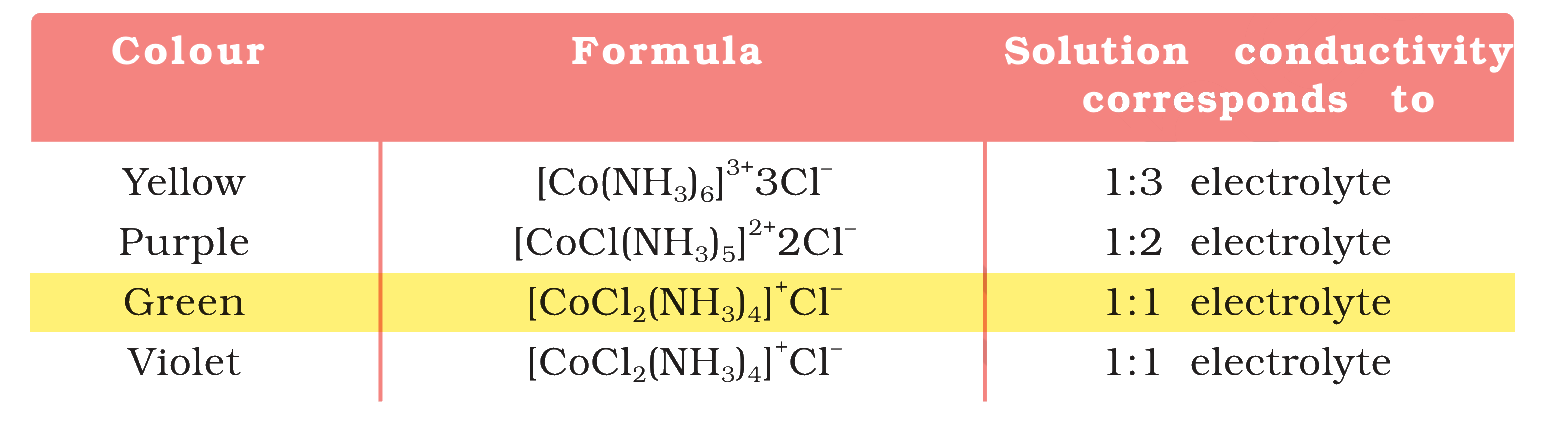
Table 5.1: Formulation of Cobalt(III) Chloride-Ammonia Complexes