Match List-I with List-II
|
List-I (Vitamins) |
List-II (Diseases) |
|
(A) Vitamin K |
(I) Pernicious anaemia |
|
(B) Vitamin A |
(II) Osteomalacia |
|
(C) Vitamin \( B_{12} \) |
(III) Increase blood clotting time |
|
(D) Vitamin D |
(IV) Night blindness |
Choose the correct answer from the options given below:
Answer & explanation
Correct answer: option 4
The correct answer is Option (4) → (A)-(III), (B)-(IV), (C)-(I), (D)-(II)
Vitamins are needed in small amounts, and the lack of each one causes its own deficiency disease. Vitamins A, D, E and K are fat soluble; the B group and vitamin C are water soluble.
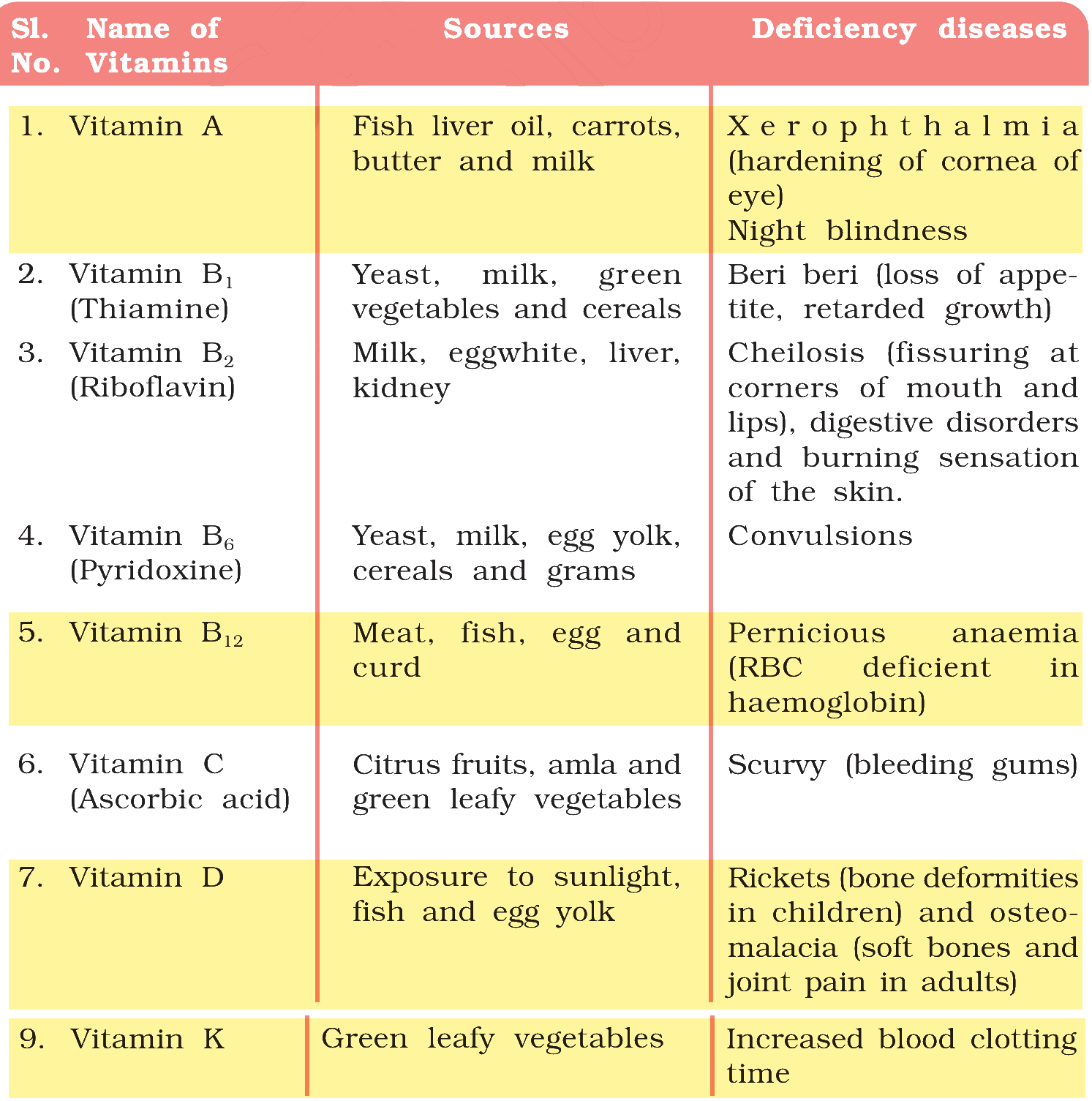
(A) Vitamin K — This matches (III) Increase blood clotting time. Vitamin K is needed to make the clotting factors of blood, so without it the blood takes longer to clot.
(B) Vitamin A — This matches (IV) Night blindness. Vitamin A forms the light-sensitive pigment of the eye; its lack causes night blindness and xerophthalmia (hardening of the cornea).
(C) Vitamin \(B_{12}\) — This matches (I) Pernicious anaemia. Vitamin B12 (cyanocobalamin, a cobalt compound) is needed to form red blood cells; its lack gives RBCs deficient in haemoglobin.
(D) Vitamin D — This matches (II) Osteomalacia. Vitamin D controls the absorption of calcium; its lack causes soft bones (osteomalacia) in adults and rickets in children.
Shortcut: (A)-(III) appears only in Option (4).
NCERT (2026-27 edition):
Classification of Vitamins – …