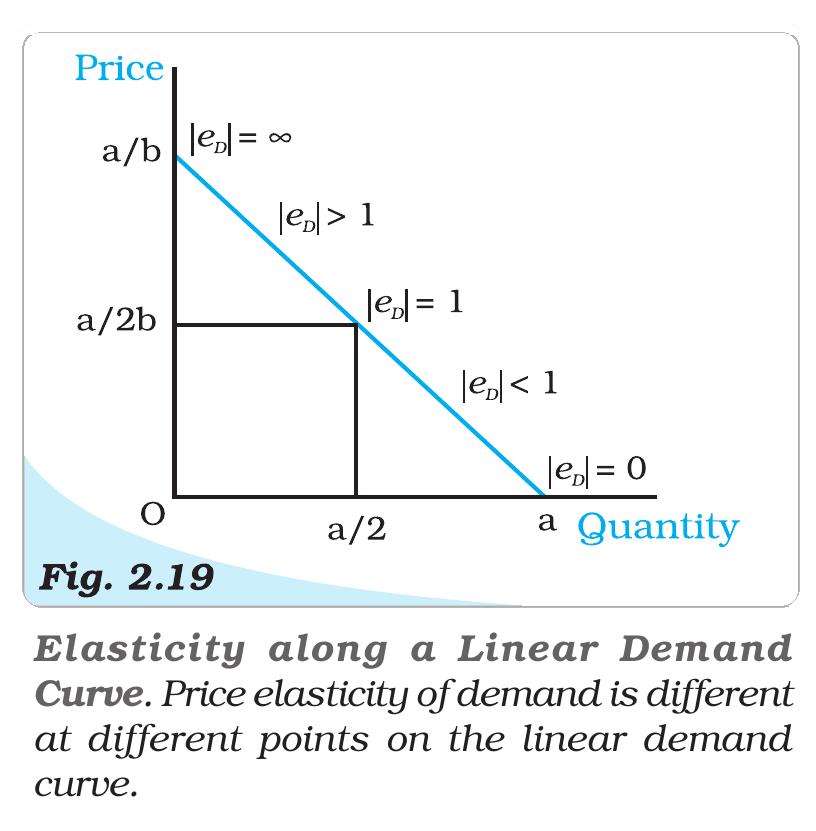
Arrange the following statement in the context of elasticity along a linear demand curve (left to right).
(A) \( e_D = 1 \)
(B) \( e_D > 1 \)
(C) \( e_D = 0 \)
(D) \( e_D < 1 \)
Choose the correct answer from the options given below:
Answer & explanation
Correct answer: option 3
The correct answer is Option (3) → (B), (A), (D), (C)
Price elasticity of demand (eD) measures how strongly demand responds to a change in price. On a straight-line demand curve it falls steadily from left to right. The values below are taken without the minus sign.
(B) \( e_D > 1 \) — This holds at any point to the left of the midpoint.
(A) \( e_D = 1 \) — This holds at the midpoint of the demand curve.
(D) \( e_D < 1 \) — This holds at any point to the right of the midpoint.
(C) \( e_D = 0 \) — This holds at the point where the demand curve meets the horizontal axis, where the price is zero.
Note: A same/similar question was asked in CUET (UG) in the papers below.
| 2026 | 2025 | 2024 | 2023 | 2022 |
| – | 22-05 S1* 30-05 S2 | – | 13-06 S1* | – |
* A similar question.
NCERT (2026-27): “Geometric Measure of Elasticity along a Linear Demand Curve … The elasticity of demand at different points on a straight line demand curve can be derived by this method. Elasticity is 0 at the point where the demand curve meets the horizontal axis and it is ∞ at the point where the demand curve meets the vertical axis. At the midpoint of the demand curve, the elasticity is 1, at any point to the left of the midpoint, it is greater than 1 and at any point to the right, it is less than 1.”
|