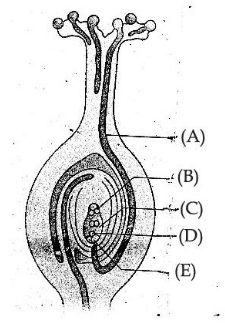
The figure given above shows the growth of pollen tube. Observe the figure and answer the following question.
The ploidy of parts (D) and (E) are:
Answer & explanation
Correct answer: option 3
The correct answer is Option (3) → (D) -n (E) -n
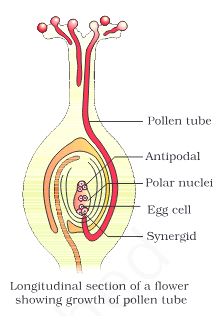
There is a characteristic distribution of the cells within the embryo sac. Three cells are grouped together at the micropylar end and constitute the egg apparatus. The egg apparatus, in turn, consists of two synergids and one egg cell. The synergids have special cellular thickenings at the micropylar tip called filiform apparatus, which play an important role in guiding the pollen tubes into the synergid. Three cells are at the chalazal end and are called the antipodals. The large central cell, has two polar nuclei. Thus, a typical angiosperm embryo sac, at maturity, though 8-nucleate is 7-celled.
The synergids are two cells that are located at the micropylar end of the embryo sac. They are responsible for attracting the pollen tube and guiding it to the egg cell. Once the pollen tube has entered the embryo sac, the synergids degenerate.These are haploid.
In plants, the egg cell is part of the female gametophyte (or embryo sac), which develops from a haploid megaspore and thus contains haploid cells, including the egg and synergids.