The most stable oxidation state of titanium is
Answer & explanation
Correct answer: option 3
The correct answer is Option (3) → Ti4+
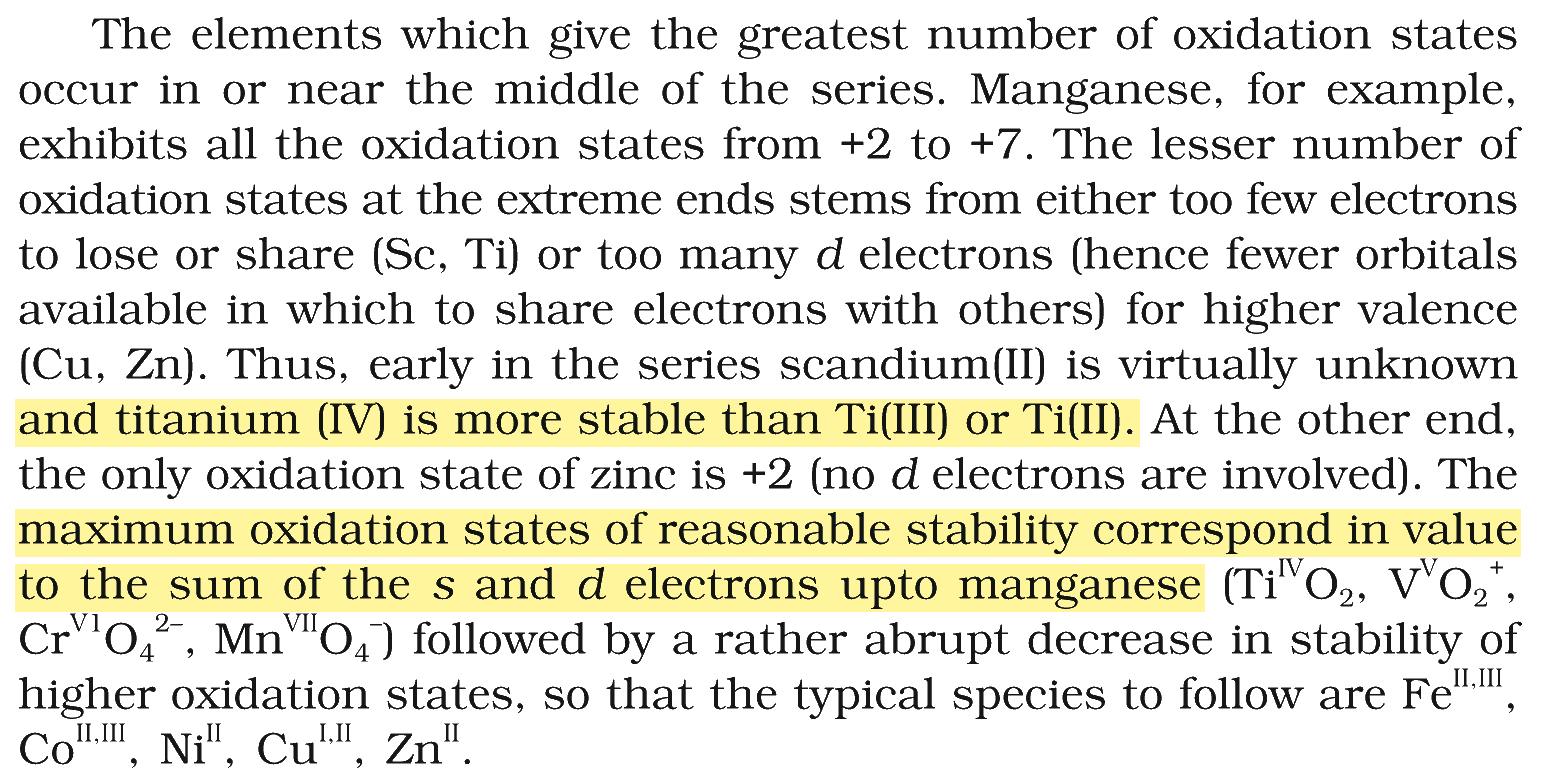
In the first half of the 3d series, an element can use all its 3d and 4s electrons in bonding. The highest oxidation state therefore equals the total number of these electrons, and for the early members this highest state is also the most stable one:
Sc +3, Ti +4, V +5, Cr +6, Mn +7
Titanium (Z = 22) has the configuration [Ar] 3d2 4s2. When it loses all four outer electrons, \( \ce{Ti^{4+}} \) is left with the stable [Ar] configuration (3d0).
\( \displaystyle \ce{Ti} \ ([\mathrm{Ar}]\,3d^{2}\,4s^{2}) \rightarrow \ce{Ti^4+} \ ([\mathrm{Ar}]) \)
That is why titanium is found mostly as Ti(IV) compounds, such as \( \ce{TiO2} \) and \( \ce{TiCl4} \). So the most stable oxidation state of titanium is +4.
Why the other options are incorrect
Option (1) Ti3+ — Incorrect. \( \ce{Ti^{3+}} \) (both 4s electrons and one 3d electron removed: 3d1) exists, but it is a reducing agent and is easily oxidised to \( \ce{Ti^{4+}} \).
Option (2) Ti2+ — Incorrect. \( \ce{Ti^{2+}} \) (only the two 4s electrons removed: 3d2) is an even stronger reducing agent and is rarely met.
Option (4) Ti5+ — Incorrect. A fifth electron would have to come from the stable argon core, which needs far too much energy, so \( \ce{Ti^{5+}} \) does not form.
NCERT (2026-27 edition):
Oxidation States – …