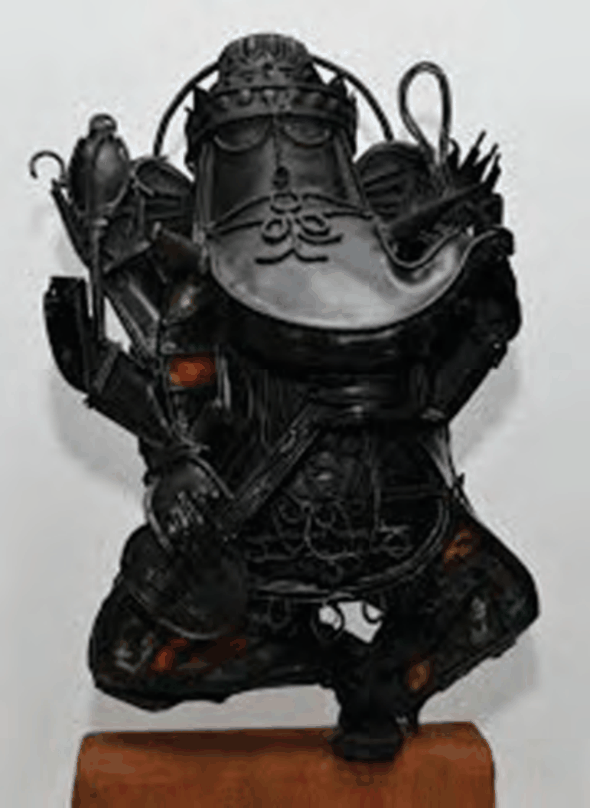
Ganesha is a 1970 sculpture in oxidised copper. By which of the following was its sculptor influenced?
Answer & explanation
Correct answer: option 1
The correct answer is Option (1) → The ancient temple sculpture of South India
Option (1) The ancient temple sculpture of South India — Correct. P. V. Janakiram was influenced by the ancient temple sculpture of South India; his frontal Ganesha has the character of cave and temple sculpture.
Option (2) The Ajanta frescoes and Mughal miniature paintings — Incorrect. These inspired Nandalal Bose and Asit Kumar Haldar at Kala Bhavana, not Janakiram.
Option (3) The sand casting technique of local Rajasthani artists — Incorrect. K. G. Subramanyan learned sand casting from Rajasthani artists for his relief murals.
Option (4) The motifs of Tamil and Sanskrit scripts and floor decorations — Incorrect. K. C. S. Paniker drew on these motifs for his abstraction.
NCERT (2026-27): “Ganesha This is a sculpture in oxidised copper made by P. V. Janakiram in 1970, and is in the collection of NGMA, Delhi. He has used sheets of copper to create pictorial sculpture as free-standing forms, and ornamented their surface with linear elements. …Janakiram is influenced by the ancient temple sculpture of South India. The image of Ganesha, crafted frontally, lends an important indigenous character of cave and temple sculpture.…”
|