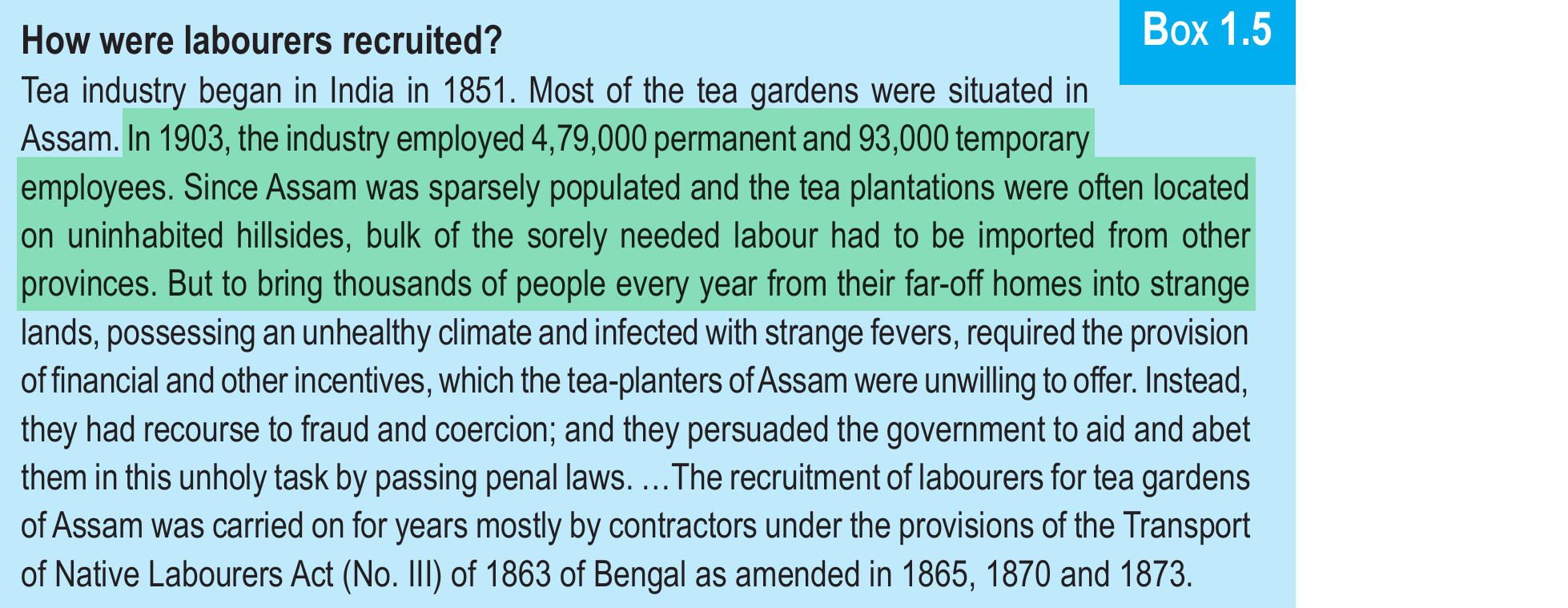
The tea industry began in India in 1851. Most of the tea gardens were situated in Assam. Since Assam was sparsely populated and the tea plantations were often located on uninhabited hillsides, the bulk of the sorely needed labour had to be imported from other provinces. But to bring thousands of people every year from their far-off homes into strange lands, possessing an unhealthy climate required the provision of financial and other incentives which the tea planters were unwilling to offer. Instead they took recourse to fraud coercion and persuaded the government to pass regressive penal laws. Thus the recruitment of labourers for tea gardens of Assam was carried on by contractor under the provisions of transport of Native Labourers Act (No 111) of 1863 of Bengal as amended in 1865, 1870 and 1873.
Read the passage given above and answer the questions:
Tea industry during colonial times was ___.
Answer & explanation
Correct answer: option 1
The correct answer is Option (1) → Labour intensive
Option (1) Labour intensive — Correct. A labour-intensive industry depends on a large number of workers rather than on machines. Tea gardens needed so many hands that thousands of people had to be imported every year from other provinces; in 1903 the industry employed 4,79,000 permanent and 93,000 temporary workers.
Note: The term in Option (1), ‘labour intensive’, is not in NCERT (2025-26); explained here for the benefit of the students.
NCERT: Social Change and Development in India — Chapter 1: Structural Change, Box 1.5 (2025-26)
|