
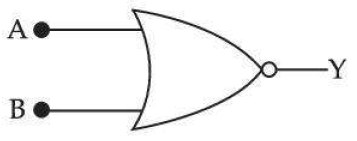
(A) This is a NAND gate
(B) if A = 0, B = 0 then Y = 1
(C) if A = 0, B = 1 then Y = 0
(D) if A = 1, B = 0 then Y = 1
(E) if A = 1, B = 1 then Y = 1
Choose the correct answer from the options given below:
Answer & explanation
Correct answer: option 3
The correct answer is Option (3) → (B) and (C) only
The symbol has the curved input side and pointed output of an OR gate, followed by a small circle (bubble) that inverts the output. So it is a NOR gate:
\( \displaystyle Y = \overline{A + B} \)
The output is 1 only when both inputs are 0; if either input is 1, the output is 0.
(A) This is a NAND gate — Incorrect. A NAND gate has the D-shaped body of an AND gate with a bubble. The body drawn here is the OR shape, so the gate is NOR.
(B) if A = 0, B = 0 then Y = 1 — Correct. \( A + B = 0 \), and its inverse is 1, so the output is high when both inputs are low.
(C) if A = 0, B = 1 then Y = 0 — Correct. \( A + B = 1 \), and the bubble inverts it to 0.
(D) if A = 1, B = 0 then Y = 1 — Incorrect. Here too \( A + B = 1 \), so the output is 0, not 1.
(E) if A = 1, B = 1 then Y = 1 — Incorrect. \( A + B = 1 \) again, so Y = 0.
Note: This question is from the pre-rationalised NCERT book (2022-23). The topic was removed from the latest NCERT book (2026-27), and it also appears to be out of the CUET 2026 syllabus.
NCERT (Pre-rationalised edition, 2022-23):
Logic Gates – “… It has two or more inputs and one output. A NOT- operation applied after OR gate gives a NOT-OR gate (or simply NOR gate). Its output Y is ‘1’ only when both inputs A and B are ‘0’, i.e., neither one input nor the other is ‘1’.”