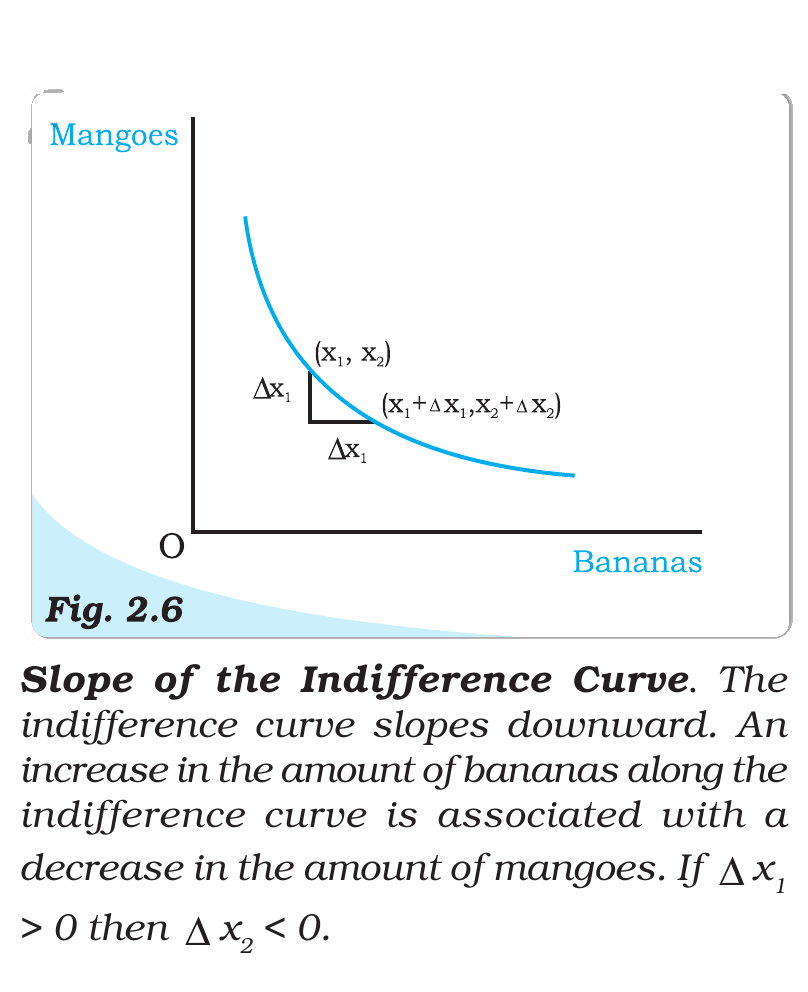
The indifference curve for goods x1 and x2 is sloped downwards when?
Answer & explanation
Correct answer: option 2
The correct answer is Option (2) → Δx1 > 0 and Δx2 < 0
All bundles on one indifference curve give the same satisfaction, and with monotonic preferences more of a good always makes the consumer better off. So if the consumer gets more of good 1 (Δx1 > 0), the same satisfaction is kept only by giving up some of good 2 (Δx2 < 0). The opposite signs make the curve slope downwards.
Why the other options are incorrect
Option (1) Δx1 > 0 and Δx2 > 0 — Incorrect. More of both goods gives a bundle the consumer prefers, so it lies on a higher indifference curve, not on the same one.
Option (3) Δx1 >1 and Δx2 < 0 — Incorrect. The slope depends on the signs of the two changes, not on whether a change is larger than 1; the condition Δx1 > 1 leaves out every small increase.
Option (4) Δx1 > 1 and Δx2 > 1 — Incorrect. Both goods increase, so the consumer moves to a higher indifference curve.
NCERT (2025-26): “Features of Indifference Curve 1. Indifference curve slopes downwards from left to right: An indifference curve slopes downwards from left to right, which means that in order to have more of bananas, the consumer has to forego some mangoes. If the consumer does not forego some mangoes with an increase in number of bananas, it will mean consumer having more of bananas with same number of mangoes, taking her to a higher indifference curve. Thus, as long as the consumer is on the same indifference curve, an increase in bananas must be compensated by a fall in quantity of mangoes.…”
|