Arrange the following steps involved in the process of credit creation by Commercial Banks.
(A) The commercial bank lends the excess reserves to the borrowers.
(B) The borrowers deposit the loaned money in the bank.
(C) The bank keeps a portion of the lent deposit money as reserve.
(D) The initial deposit is made in the commercial bank.
Choose the correct answer from the options given below:
Answer & explanation
Correct answer: option 3
The correct answer is Option (3) → (D), (C), (B), (A)
Note: The given answer is as per the official NTA Answer Key. However, there seems to be an ambiguity in the question. Borrowers can deposit the loaned money only after the bank lends it. So the cause-and-effect order is (D), (C), (A), (B), which is not among the options, as explained below.
Credit creation means that banks create deposits many times larger than the first cash deposit. Each loan comes back to the bank as a new deposit, so the process repeats:
(D) The initial deposit is made in the commercial bank. — It starts with a deposit of cash, say Rs 100.
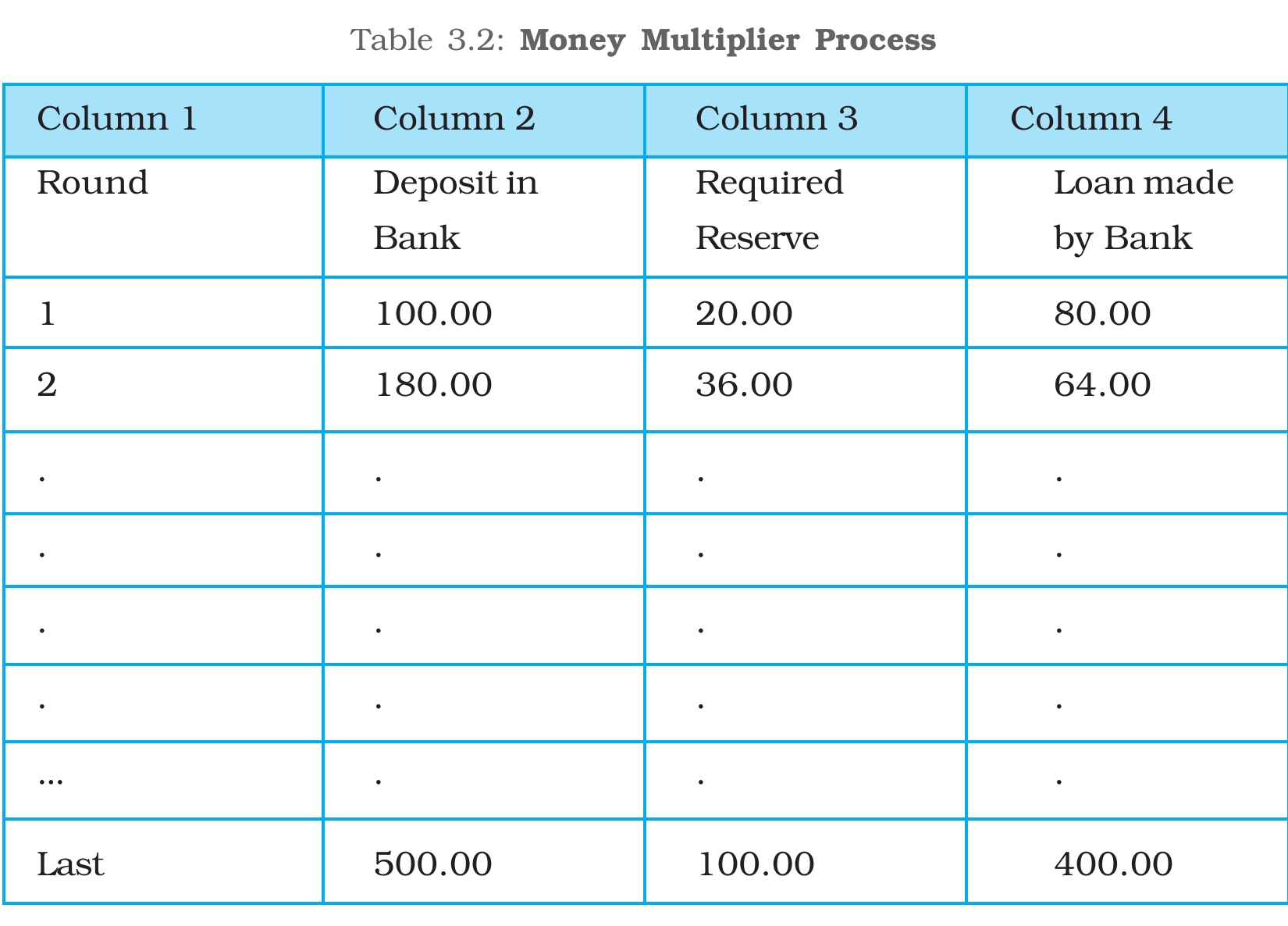
(C) The bank keeps a portion of the lent deposit money as reserve. — The bank must keep a fixed share as reserves (the legal reserve ratio), say 20 per cent. It keeps Rs 20. The other Rs 80 is excess reserves (money free to lend).
(A) The commercial bank lends the excess reserves to the borrowers. — The bank lends the Rs 80.
(B) The borrowers deposit the loaned money in the bank. — The Rs 80 comes back as a deposit, so deposits become Rs 180. The bank keeps Rs 36 and can lend Rs 64 more.
Deposits finally reach Rs 500, that is \( \frac{1}{0.2} = 5 \) times the first deposit. This is the money multiplier, \( \frac{1}{\text{reserve ratio}} \).
In NTA’s order (D), (C), (B), (A), the first lending has to be taken as understood between (C) and (B). Then (B) and (A) show the loan coming back as a deposit and the bank lending again (Rs 64).
NCERT (2026-27): “3.3.2 Limits to Credit Creation and Money Multiplier … Let us assume that our bank starts with a deposit of Rs 100 made by Leela. The reserve ratio is 20 per cent. Thus our bank has Rs 80 (100 – 20) to lend and the bank lends out Rs 80 to Jaspal Kaur, which shows up in the bank’s deposits in the next round as liabilities, making a total of Rs 180 as deposits. Now our bank is required to keep 20 per cent of 180 i.e. Rs 36 as cash reserves. Recall that our bank had started with Rs 100 as cash. Since it is required to keep only Rs 36 as reserves, it can lend Rs 64 again (100 – 36 = 64). The bank lends out Rs 64 to Junaid. This in turn shows up in the bank as deposits. The process keeps repeating itself till all the required reserves become Rs 100.… …The process is illustrated in Table 3.2.”
|