For predicting the straight-line trend in the sales of washing machines (in thousands) on the basis of 8 consecutive years data, the company calculates 4 year moving averages. If the sales of washing machines for respective years are a, b, c, d, e, f, g and h, then which of the following averages will be computed?
(A) \(\displaystyle\frac{a+b+c+d}{4}\)
(B) \(\displaystyle\frac{a+c+d+e}{4}\)
(C) \(\displaystyle\frac{c+d+f+h}{4}\)
(D) \(\displaystyle\frac{b+c+d+e}{4}\)
Choose the correct answer from the options given below:
Answer & explanation
Correct answer: option 2
The correct answer is Option (2) → (A) and (D) only
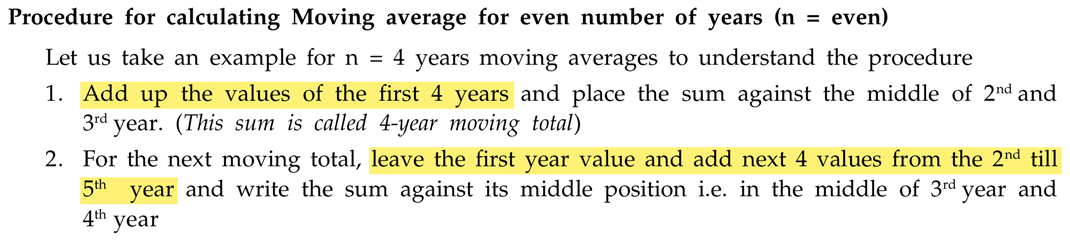
A 4-year moving average is the average of 4 consecutive years. The window starts at the first year and moves forward one year at a time, so the averages computed are
\( \displaystyle \frac{a+b+c+d}{4},\ \frac{b+c+d+e}{4},\ \frac{c+d+e+f}{4},\ \frac{d+e+f+g}{4},\ \frac{e+f+g+h}{4} \)
So only sums of four consecutive years appear: a to d, b to e, c to f, d to g and e to h.
Checking the statements
(A) \(\frac{a+b+c+d}{4}\) — Correct. Years a, b, c, d are consecutive (the first average).
(B) \(\frac{a+c+d+e}{4}\) — Incorrect. Year b is skipped, so the years are not consecutive.
(C) \(\frac{c+d+f+h}{4}\) — Incorrect. Years e and g are skipped.
(D) \(\frac{b+c+d+e}{4}\) — Correct. Years b, c, d, e are consecutive (the second average).
CBSE Applied Mathematics (Class XII):
Trend Analysis by Moving Average Method