CUETMOCK
  • Pricing
  • Mentors
Log inStart freeStart free mocks→

First test, then trust

Try a free CUET mock test.

Join 5,00,000+ students who rehearsed exam day on the exact NTA screen before sitting CUET. On the web and on Android.

Start free mocks →Get the Android app
CUETMOCK

India's #1 CUET Mock Test Platform. Original NCERT-based questions on the exact NTA exam screen — trusted by 5,00,000+ students since CUET 2022.

Get it onGoogle PlayScan to download the CUETMOCK app

Mock tests

  • CUET mock test series
  • Browse all papers
  • Commerce mocks
  • Humanities (Arts) mocks
  • Science mocks
  • Languages & GAT mocks
  • Free practice questions
  • Pricing

Resources

  • CUET exam guide
  • CUET syllabus
  • Universities accepting CUET
  • Expert blogs
  • News & notifications
  • Webinars & counselling
  • CUET score calculator
  • How we estimate your rank
  • FAQs

Company

  • About us
  • Our leadership & team
  • Our toppers
  • Mentors
  • For schools
  • Contact us
  • Terms
  • Privacy
  • Refund policy

Talk to us

+91 7696 6630 56info@cuetmock.comWhatsApp us

Our other platforms

  • JEE Mock — For IIT-JEE aspirants
  • NEET Mock — For NEET aspirants

Newsletter

Exam updates, study material and offers — no spam.

© 2026 NYC Ventures Pvt. Ltd.

701-702, Royal Business Park, Zirakpur, Punjab - 140603

  • Terms of use
  • Privacy policy
  • Refund policy
  • Contact us

iCUETMOCK is an independent preparation platform, not affiliated with the National Testing Agency (NTA). Always check exam details on the official NTA website.

  • Home
  • Mock tests
  • CUET guide
  • Pricing
  • Log in
Home/Practice questions/History
HistoryAncient India: Bricks, Beads and Bones

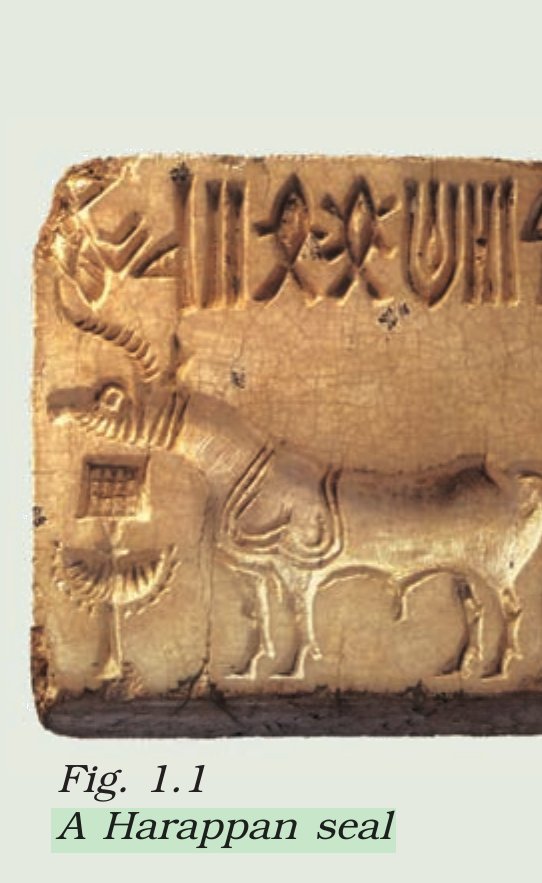
Harappan Seals were mostly made up of _____.

Harappan Seals were mostly made up of _____.

Answer & explanation+

Correct answer: option 1

The correct answer is Option (1) → Steatite

The Harappan seal, the most distinctive artefact of the civilisation, was made of a stone called steatite.


NCERT (2026-27): “The Harappan seal (Fig.1.1) is possibly the most distinctive artefact of the Harappan or Indus valley civilisation. Made of a stone called steatite, seals like this one often contain animal motifs and signs from a script that remains undeciphered. Yet we know a great deal about the lives of the people who lived in the region from what they left behind – their houses, pots, ornaments, tools and seals – in other words, from archaeological evidence.…”

NCERT extract

Advertisement

Practise more on Ancient India: Bricks, Beads and Bones

Chapter-wise mocks on the real NTA exam screen, with solutions and your rank. Your first mocks are free.

Start free mocks →

Advertisement

Next questions

  1. The settlements which extend on both sides of a river where there is a bridge or a ferry are called ______.Geography · Fundamentals of Human Geography: Human Settlements
  2. Chloroform is largely used forChemistry · Organic: Haloalkanes and Haloarenes
  3. Which of the following countries was accepted as the successor state of the Soviet Union?Political Science · Contemporary World Politics: End of Bi-Polarity
  4. Fill in the blank with the most appropriate modal:Look at the long queue outside Gupta Sweets. Their jalebis ______ be really good.English · Grammar: Modal
  5. ₹21,000 is to be distributed between Raj and Karan such that Raj gets ₹9,000 less than Karan. What is the ratio of the amount received by R…General Aptitude Test · Numerical Ability
  6. How does energy vary in this case?Physics · Electrostatic Potential and Capacitance
  7. Which of the following is a vocational course tailored to prepare students for a career in a law firm in U.K.?Legal Studies · Legal Profession in India
  8. The presence of naturalised human is prevalent in the doctrines of ____.Geography · Fundamentals of Human Geography: Human Geography-Nature and Scope
  9. Select the correctly spelt word.English · Spelling Check
  10. Let f(x)=|x| and g(x)=[x] , then the value of fog≤ft(-displaystyle9/2)-gof≤ft(-displaystyle9/2) is:Maths. Section B1 · Relations and Functions