
CUETMOCK
  • Pricing
  • Mentors
Log inStart freeStart free mocks→

First test, then trust

Try a free CUET mock test.

Join 5,00,000+ students who rehearsed exam day on the exact NTA screen before sitting CUET. On the web and on Android.

Start free mocks →Get the Android app
CUETMOCK

India's #1 CUET Mock Test Platform. Original NCERT-based questions on the exact NTA exam screen — trusted by 5,00,000+ students since CUET 2022.

Get it onGoogle PlayScan to download the CUETMOCK app

Mock tests

  • CUET mock test series
  • Browse all papers
  • Commerce mocks
  • Humanities (Arts) mocks
  • Science mocks
  • Languages & GAT mocks
  • Free practice questions
  • Pricing

Resources

  • CUET exam guide
  • CUET syllabus
  • Universities accepting CUET
  • Expert blogs
  • News & notifications
  • Webinars & counselling
  • CUET score calculator
  • How we estimate your rank
  • FAQs

Company

  • About us
  • Our leadership & team
  • Our toppers
  • Mentors
  • For schools
  • Contact us
  • Terms
  • Privacy
  • Refund policy

Talk to us

+91 7696 6630 56info@cuetmock.comWhatsApp us

Our other platforms

  • JEE Mock — For IIT-JEE aspirants
  • NEET Mock — For NEET aspirants

Newsletter

Exam updates, study material and offers — no spam.

© 2026 NYC Ventures Pvt. Ltd.

701-702, Royal Business Park, Zirakpur, Punjab - 140603

  • Terms of use
  • Privacy policy
  • Refund policy
  • Contact us

iCUETMOCK is an independent preparation platform, not affiliated with the National Testing Agency (NTA). Always check exam details on the official NTA website.

  • Home
  • Mock tests
  • CUET guide
  • Pricing
  • Log in
Home/Practice questions/General Aptitude Test
General Aptitude TestVerbal ReasoningBlood Relations

Pointing to a lady in the photograph, Sujata said, "Her son's father…

Pointing to a lady in the photograph, Sujata said, "Her son's father is the son-in-law of my mother." How is Sujata related to the lady?

Answer & explanation+

Correct answer: option 2

The correct answer is Option (2) → Sister

A statement of this kind is solved one relation at a time, starting with the lady in the photograph:

  • “Her son’s father” — the father of the lady’s son is the lady’s husband

  • “The son-in-law of my mother” — a son-in-law is a daughter’s husband, so the lady’s husband is married to a daughter of Sujata’s mother

  • That daughter is the lady herself. The lady in the photograph is someone other than Sujata, so she is another child of Sujata’s mother, and Sujata and the lady are sisters
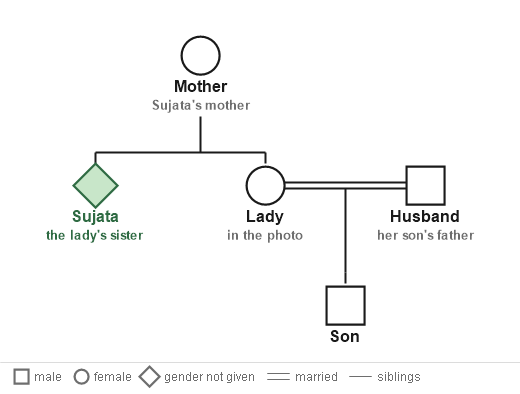
Figure for the solution

Advertisement

Practise more on Verbal Reasoning

Chapter-wise mocks on the real NTA exam screen, with solutions and your rank. Your first mocks are free.

Start free mocks →

Advertisement

Next questions

  1. From the options given below, choose the correctly spelt word.English · Spelling Check
  2. The Union and Pacific Railway does NOT pass through which of the following cities ?Geography · Fundamentals of Human Geography: Transport and Communication
  3. The bar graph given below shows production of truck by two companies L and M in 5 years. Which of the following statement is NOT correct? I…General Aptitude Test · Quantitative Reasoning
  4. Which of the following ions are coloured in solution?Chemistry · Inorganic: D and F Block Elements
  5. Ratio of the wavelengths of first line of Lyman series and first line of Balmer series isPhysics · Atoms
  6. What is another term used to describe decomposers that highlight their role in decomposition?Biology · Ecosystem
  7. In a nearly saturated solution, which of the following statements are correct? A. If dissolution process is endothermic, solubility increas…Chemistry · Physical: Solutions
  8. Careful monitoring of an organization's internal and external environment for detecting early signs of opportunities and threats is known a…Entrepreneurship · Entrepreneurial Opportunity
  9. If […] =k(x-4)^2 , then the value of k is:Maths. Section B1 · Determinants
  10. Which of the following is an example of learning attitudes by association?Psychology · Attitudes and Social Cognition