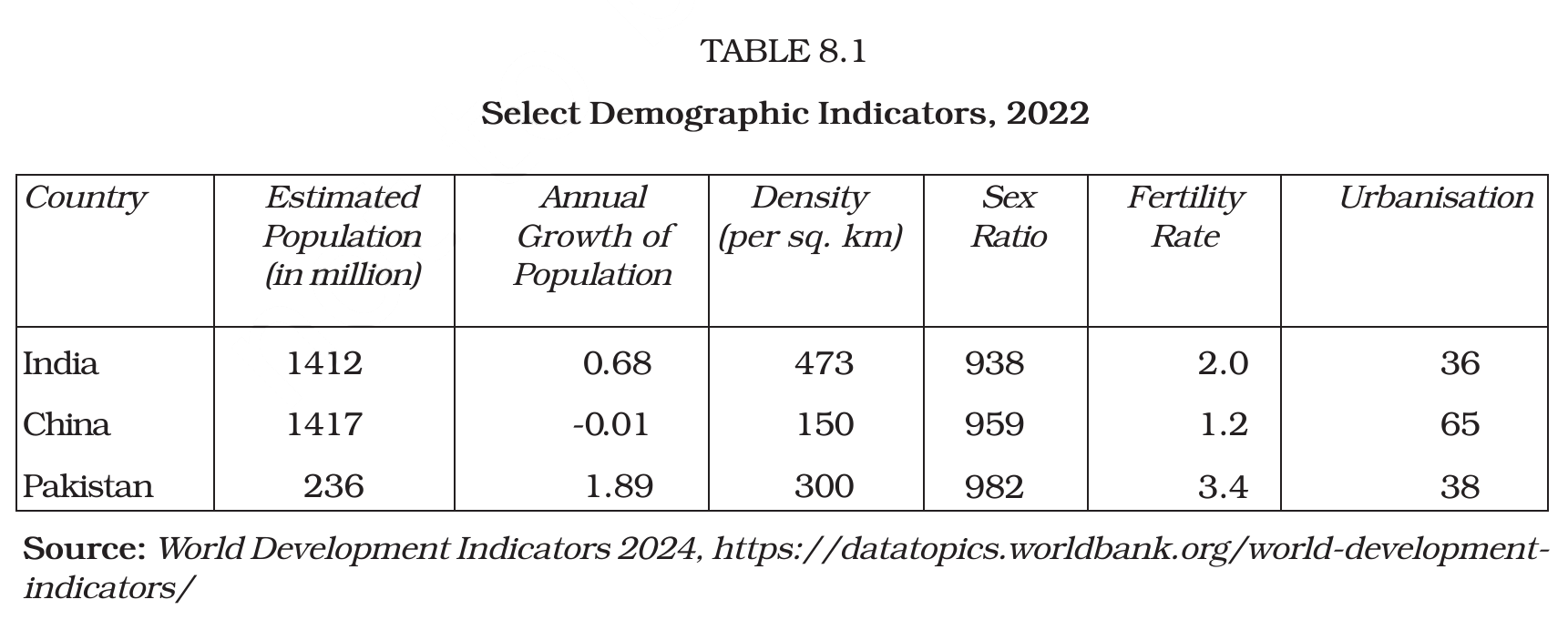
Choose the correct statement in respect to India, Pakistan and China.
Answer & explanation
Correct answer: option 1
The correct answer is Option (1) → The sex ratio is low and biased against females in all three countries.
The sex ratio, the number of females per 1000 males, shows how a society treats its girls. In India, China and Pakistan it is below 1000 — low and biased against females in all three countries, which scholars put down to the son preference in all of them. In China the one-child norm also lowered the ratio.
Why the other options are incorrect
Option (2) India and Pakistan are ahead of China in reducing proportion of people below the poverty line. — Incorrect. China is ahead of both in reducing the share of its people below the poverty line; India lags behind Pakistan and China on this count.
Option (3) China has the largest share of poor among the three countries. — Incorrect. China has brought the proportion of its people below the poverty line close to zero, so it has the smallest share of poor, not the largest.
Option (4) India is ahead of China and Pakistan on many human development indicators. — Incorrect. China is moving ahead of India and Pakistan on most indicators — income per head, poverty, mortality, sanitation, literacy and life expectancy.
NCERT (2025-26): “8.3 Demographic Indicators … Though China is the largest nation and geographically occupies the largest area among the three nations, its density is the lowest. Table 8.1 shows the population growth as being the highest in Pakistan, followed by India and China. Scholars point out the one-child norm introduced in China in the late 1970s as the major reason for low population growth. They also state that this measure led to a decline in the sex ratio, the proportion of females per 1000 males. However, from the table, you will notice that the sex ratio is low and biased against females in all three countries. Scholars cite son preference prevailing in all these countries as the reason.…”
|