
CUETMOCK
  • Pricing
  • Mentors
Log inStart freeStart free mocks→

First test, then trust

Try a free CUET mock test.

Join 5,00,000+ students who rehearsed exam day on the exact NTA screen before sitting CUET. On the web and on Android.

Start free mocks →Get the Android app
CUETMOCK

India's #1 CUET Mock Test Platform. Original NCERT-based questions on the exact NTA exam screen — trusted by 5,00,000+ students since CUET 2022.

Get it onGoogle PlayScan to download the CUETMOCK app

Mock tests

  • CUET mock test series
  • Browse all papers
  • Commerce mocks
  • Humanities (Arts) mocks
  • Science mocks
  • Languages & GAT mocks
  • Free practice questions
  • Pricing

Resources

  • CUET exam guide
  • CUET syllabus
  • Universities accepting CUET
  • Expert blogs
  • News & notifications
  • Webinars & counselling
  • CUET score calculator
  • How we estimate your rank
  • FAQs

Company

  • About us
  • Our leadership & team
  • Our toppers
  • Mentors
  • For schools
  • Contact us
  • Terms
  • Privacy
  • Refund policy

Talk to us

+91 7696 6630 56info@cuetmock.comWhatsApp us

Our other platforms

  • JEE Mock — For IIT-JEE aspirants
  • NEET Mock — For NEET aspirants

Newsletter

Exam updates, study material and offers — no spam.

© 2026 NYC Ventures Pvt. Ltd.

701-702, Royal Business Park, Zirakpur, Punjab - 140603

  • Terms of use
  • Privacy policy
  • Refund policy
  • Contact us

iCUETMOCK is an independent preparation platform, not affiliated with the National Testing Agency (NTA). Always check exam details on the official NTA website.

  • Home
  • Mock tests
  • CUET guide
  • Pricing
  • Log in
Home/Practice questions/Biology
BiologySexual Reproduction in Flowering Plants

A typical angiosperm has bilobed anther and its microsporangium has f…

A typical angiosperm has bilobed anther and its microsporangium has four microspore mother cells. How many tetrads and pollen grains will be formed in it?

Answer & explanation+

Correct answer: option 2

The correct answer is Option (2) → 16 tetrads and 64 pollen grains

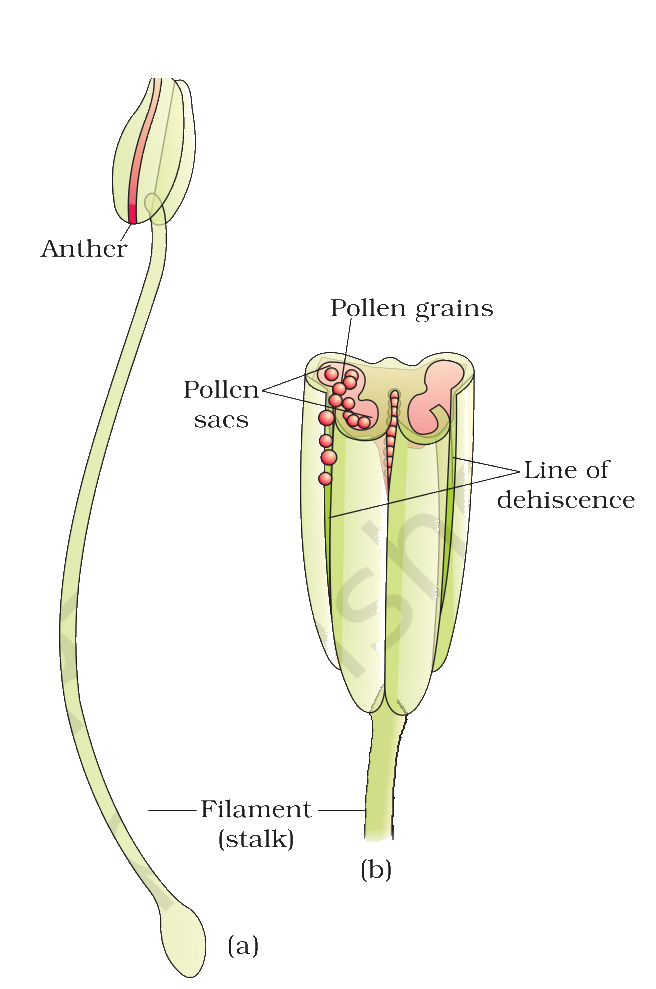
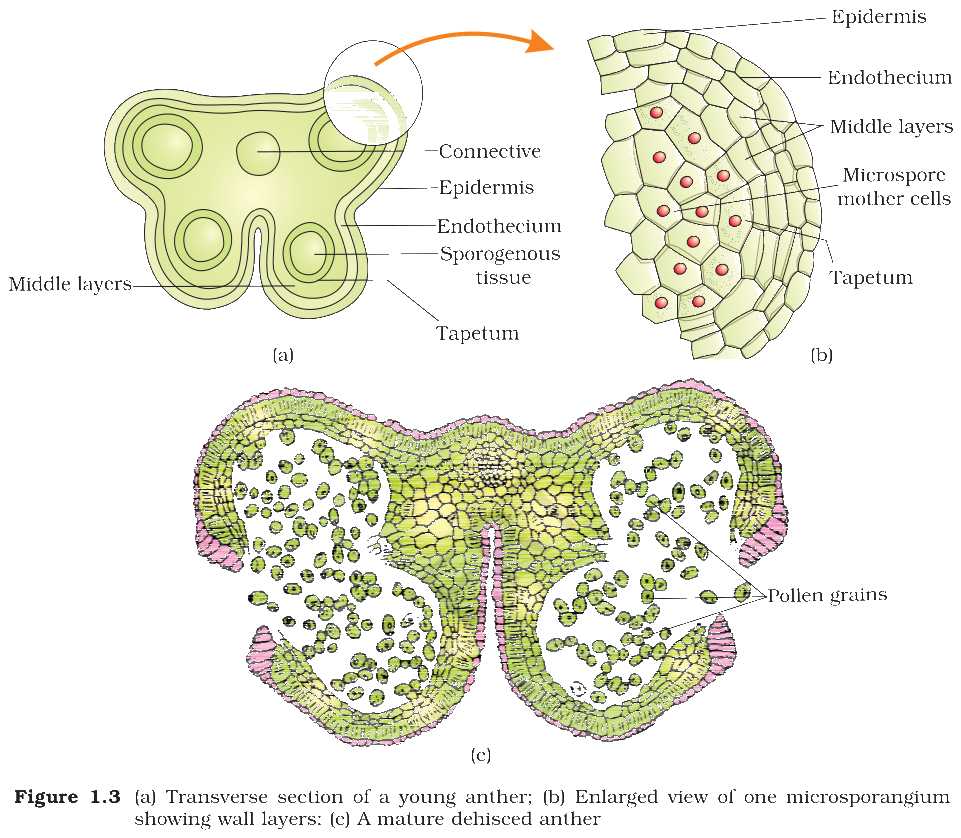
A typical angiosperm anther is bilobed, and each lobe has two theca (it is dithecous). So one anther has four microsporangia. In each microsporangium, every microspore mother cell (a cell of the sporogenous tissue) undergoes meiosis and forms one microspore tetrad, a group of four cells. Each microspore then develops into a pollen grain.

    Microsporangia in one anther = 2 lobes × 2 = 4
    Microspore mother cells = 4 microsporangia × 4 = 16
    Tetrads = 16 (one from each mother cell)
    Pollen grains = 16 × 4 = 64

(1) 4 tetrads and 4 pollen grains — Incorrect. This counts only one microsporangium, and it also forgets that each tetrad has four cells.

(2) 16 tetrads and 64 pollen grains — Correct. 16 mother cells give 16 tetrads, and each tetrad gives 4 pollen grains.

(3) 64 tetrads and 16 pollen grains — Incorrect. The two numbers are reversed. There are always four times as many pollen grains as tetrads, never fewer.

(4) 64 tetrads and 64 pollen grains — Incorrect. The number of tetrads cannot equal the number of pollen grains, because each tetrad gives four pollen grains.

NCERT Extract:
Stamen, Microsporangium and Pollen Grain – “… A typical angiosperm anther is bilobed with each lobe having two theca, i.e., they are dithecous …. Often a longitudinal groove runs lengthwise separating the theca. Let us understand the various types of tissues and their organisation in the transverse section of an anther …. The bilobed nature of an anther is very distinct in the transverse section of the anther. The anther is a four-sided (tetragonal) structure consisting of four microsporangia located at the corners, two in each lobe.”
Stamen, Microsporangium and Pollen Grain – “… As the anther develops, the cells of the sporogenous tissue undergo meiotic divisions to form microspore tetrads.”
Textbook figure

Figure 1.2 (a) A typical stamen; (b) three–dimensional cut section of an anther
Textbook figure

Advertisement

Practise more on Sexual Reproduction in Flowering Plants

Chapter-wise mocks on the real NTA exam screen, with solutions and your rank. Your first mocks are free.

Start free mocks →

Advertisement

Next questions

  1. What is the central concern of the passage?English · Comprehension - (Narrative / Factual)
  2. Name the author of the "Prayag Prasasti" associated with Samudra Gupta-General Aptitude Test · General Knowledge
  3. Calculate prize fund expenses incurred during the year 2021-22 from the following informationPrize fund as on 1 April, 2021 Rs. 80,000Donat…Accountancy Part A · Accounts for Non Profit Organsiation
  4. Which of the following words can fill in the blank suitably in the following sentence?The employees refused to follow the rules of the comp…English · Fill Blanks
  5. Match the idioms given in List-I with their meanings given in List-IIList-I (Idioms)List-II (Meanings)(A) Hands full(I) Leave in a difficul…English · Grammar: Idioms
  6. A pair of enantiomers differs from which of the following property ?Chemistry · Organic: Haloalkanes and Haloarenes
  7. Anubha wants to start an edu-tech platform. She wants her business to have product specialisation, greater accountability, flexibility and…Business Studies · Organising
  8. What would be the correct structure of thymine base?Chemistry · Organic: Biomolecules
  9. The following points summarise the nature of principles of management:A. Limited applicabilityB. RigidityC. General guidelinesD. Contingent…Business Studies · Principles of Management
  10. Match the LIST-I with LIST-II (In the context of a photo-electric effect experiment)LIST-ILIST-IIA. Slope of maximum kinetic energy of the…Physics · Dual Nature of Radiation and Matter