Which of the following is a credit instrument in market systems?
Answer & explanation
Correct answer: option 1
The correct answer is Option (1) → Hundi
Option (1) Hundi — Correct. The hundi was a bill of exchange, like a credit note: a merchant in one place issued it and a merchant of the same community honoured it in another, so it worked as an instrument of exchange and credit in long-distance trade.
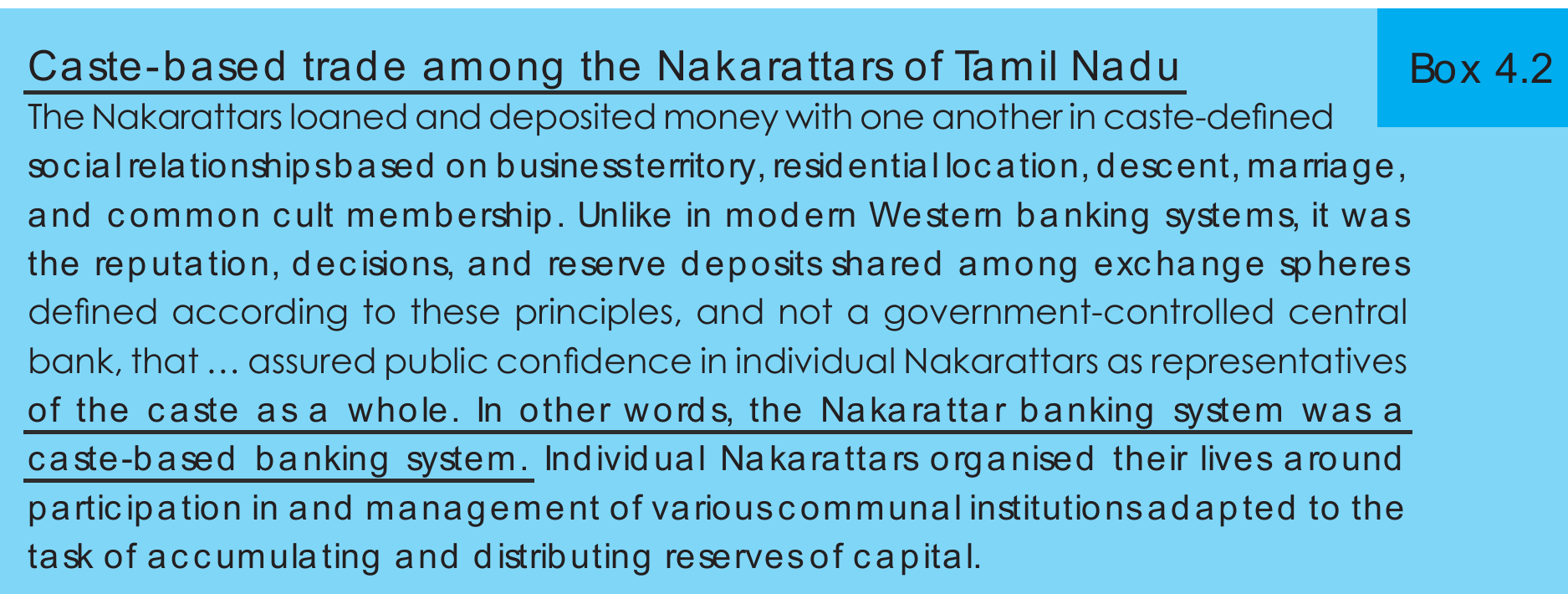
Option (2) Nakarattar — Incorrect. The Nakarattars of Tamil Nadu are a trading community; their caste-based banking system lent and deposited money within the caste. They are the people who used such instruments, not an instrument.
Option (3) Jajmani — Incorrect. The jajmani system is a non-market exchange of services and goods between castes in a village, not a credit instrument.
Option (4) Haat — Incorrect. A weekly haat is a periodic market where people buy and sell goods; it is a place of exchange, not an instrument of credit.
NCERT (2025-26): “…The weekly haat is a common sight in rural and even urban India. In hilly and forested areas (especially those inhabited by adivasis), where settlements are far-flung, roads and communications poor, and the economy relatively undeveloped, the weekly market is the major institution for the exchange of goods as well as for social intercourse.… Caste-based markets and trading networks in precolonial and colonial India … While colonialism certainly brought about major economic transformations, for example due to the demand that land revenue be paid in cash, recent historical research has shown that much of India’s economy was already extensively monetised (trade was carried out using money) in the late pre-colonial period. And while various kinds of non-market exchange systems (such as the ‘jajmani system’) did exist in many villages and regions, even during the precolonial period villages were incorporated into wider networks of exchange through which agricultural products and other goods circulated (Bayly 1983, Stein and Subrahmanyam 1996).… …These traditional trading communities or castes had their own systems of banking and credit. For instance, an important instrument of exchange and credit was the hundi, or bill of exchange (like a credit note), which allowed merchants to engage in long-distance trade.…”
|