Bromination of benzoic acid with Br2 water in the presence of catalytic amounts of FeBr3 will give
Answer & explanation
Correct answer: option 1
The correct answer is Option (1) → 3-Bromobenzoic acid
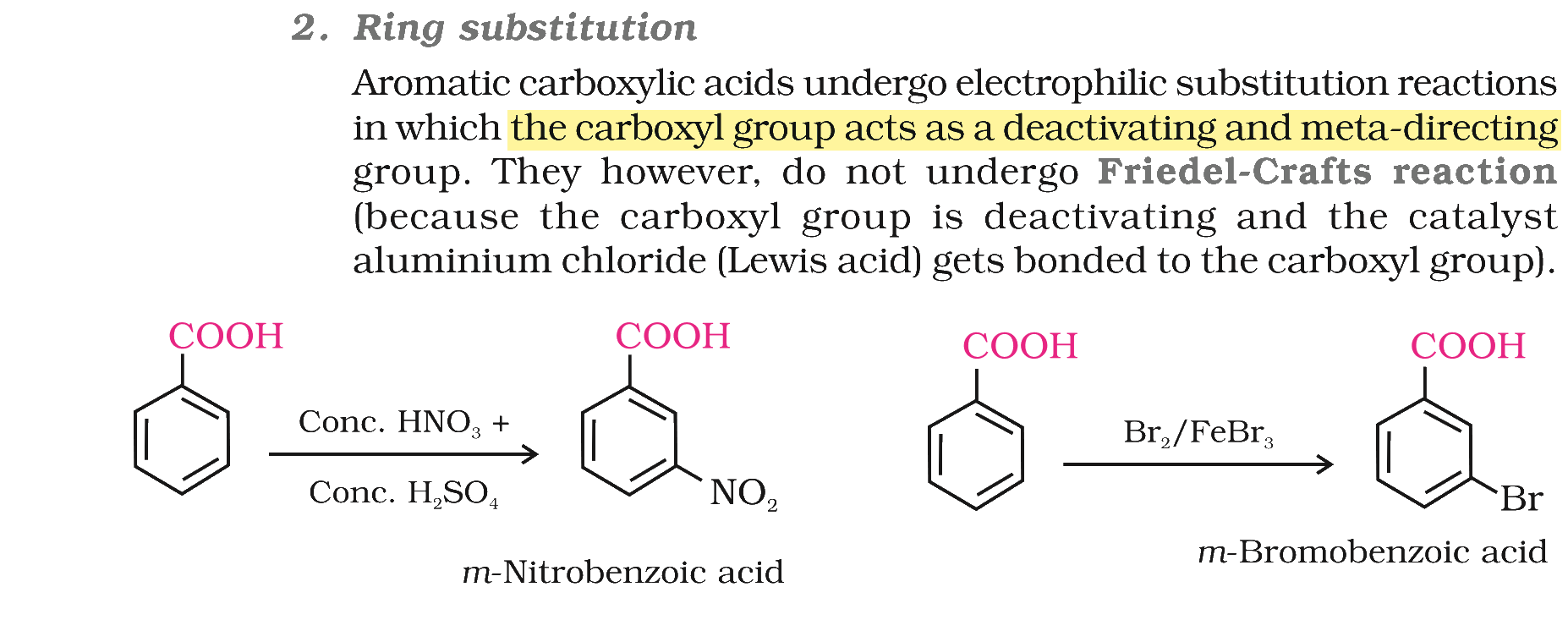
The –COOH group withdraws electrons from the benzene ring by both inductive and resonance effects. This deactivates the ring and lowers the electron density most at the ortho and para positions. So an electrophile attacks the meta position, where the density is least reduced. Carboxylic acids therefore undergo nitration and halogenation at the meta position, and do not undergo Friedel–Crafts reactions.
Bromination with bromine and the Lewis acid \( \ce{FeBr3} \) gives m-bromobenzoic acid:
\( \displaystyle \ce{C6H5COOH + Br2} \xrightarrow{\ce{FeBr3}} \ce{3-BrC6H4COOH + HBr} \)
The meta position is C-3 (the carbon carrying –COOH is C-1). So the product is 3-bromobenzoic acid.
NCERT (2026-27 edition):
Ring Substitution